There’s a moment just before you reach Osaka Castle when the city noise softens.
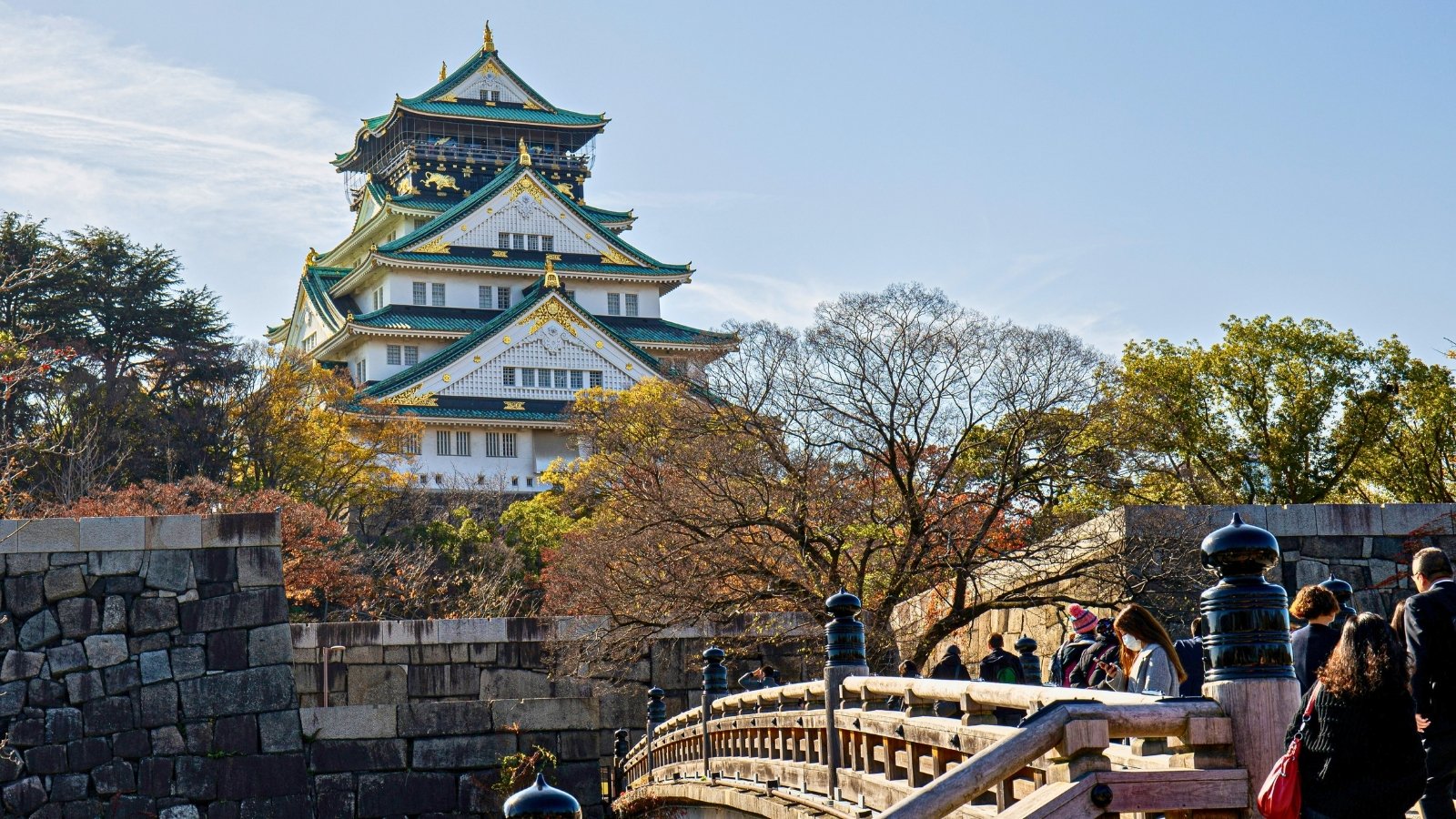
Glass towers and busy train lines fade behind rows of pine trees. The path curves. A wide moat appears. And then, rising above massive stone walls, you see it — white, green, and trimmed in gold. Osaka Castle doesn’t whisper its presence. It stands tall, confident, almost theatrical.
It’s easy to think of Osaka as Japan’s street-food capital. Neon lights. Late nights. Takoyaki eaten standing up. But long before the flashing signs of Dotonbori, this was a battleground. A power statement. A symbol of ambition.
In 1583, the warlord Toyotomi Hideyoshi chose this exact spot to build what he intended to be the greatest castle in Japan. Bigger than anything that came before it. Stronger. More imposing. A fortress that would declare the unification of a fractured nation.
It didn’t go quietly.
Osaka Castle has been burned, struck by lightning, besieged, rebuilt, destroyed again, and restored once more. What you see today is the result of centuries of resilience. And that’s part of what makes visiting Osaka Castle so compelling. It isn’t just a photogenic landmark. It’s a survivor.
Walk the grounds in spring, and you’ll find thousands of cherry blossoms framing the tower. Come in autumn, and the maple leaves turn the moat into a mirror of red and gold. Climb to the top observation deck and modern Osaka stretches in every direction — a city that grew up around a samurai dream.
If you’re planning a trip to Japan and wondering whether Osaka Castle is worth your time, the short answer is yes. But the real answer is more interesting than that.
Let’s step inside.

Quick Facts About Osaka Castle
📍 Location: Osaka, Kansai Region, Japan
🏗️ Original Construction: 1583
🏰 Architectural Style: Azuchi–Momoyama period castle architecture
🎭 Famous For: Samurai history, the Siege of Osaka, seasonal cherry blossoms, panoramic city views
👑 Notable Figure: Toyotomi Hideyoshi
🏆 UNESCO Status: No
🏛️ Current Structure: 1931 reconstruction (major restoration completed in 1997)
🌸 Best Season to Visit: Late March–early April (cherry blossoms), November (autumn foliage)
🎟️ Entrance Fee (Main Tower Museum): Paid admission required (park grounds are free, but Nishinomaru Garden requires a separate small entry fee)
🌐 Official Website: osakacastle.net, osakacastle.org

The History of Osaka Castle: Ambition, Fire, and Rebirth
To understand Osaka Castle, you have to start with ambition. Not modest ambition. Monumental ambition.
In 1583, Toyotomi Hideyoshi stood at the height of his power. Japan had been fractured for more than a century during the Sengoku period — an era of near-constant warfare between rival warlords. Hideyoshi, a former peasant who rose through the ranks under Oda Nobunaga, was close to unifying the country. What he needed now was a symbol. Something that would announce to the world that a new order had begun.
He chose the site of a former temple, Ishiyama Hongan-ji, which had already witnessed years of fierce fighting. The location was strategic. Osaka sat at a key transportation hub, connected by land and sea routes. Control this point, and you control movement, trade, and military access.
Construction began on a scale Japan had never seen.
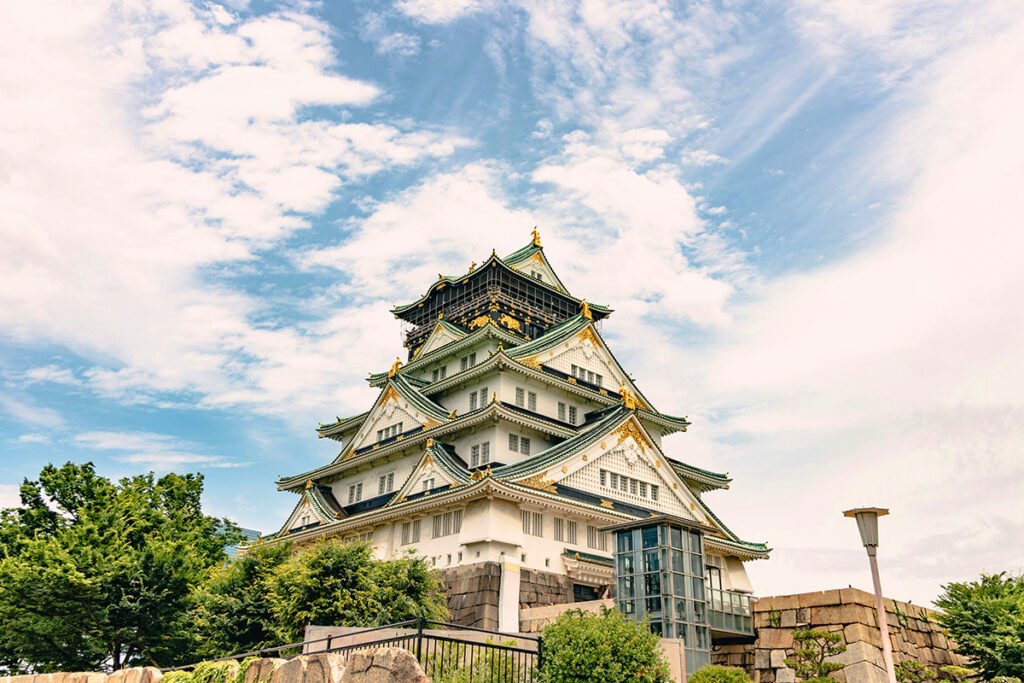
Massive granite stones were hauled from across the region. Some weigh over 100 tons. Entire daimyo (feudal lords) were ordered to contribute labor and materials — both a show of loyalty and a reminder of who was in charge. The main tower soared above the landscape, decorated with gold leaf and shimmering roof ornaments. It wasn’t just a fortress. It was a declaration.
For a brief moment, it worked.
But history rarely stays still.
After Hideyoshi’s death in 1598, power struggles resumed. His young son, Toyotomi Hideyori, inherited the castle — and the target that came with it. Tokugawa Ieyasu, another powerful warlord, saw opportunity. Tensions escalated.
The result was the Siege of Osaka.
In 1614 and 1615, Tokugawa forces surrounded the castle in two brutal campaigns — the Winter Siege and the Summer Siege. Despite Osaka Castle’s formidable moats and towering walls, the Toyotomi forces were eventually overwhelmed. The inner defenses fell. The castle burned. Hideyori died, and with him, the Toyotomi legacy.
Tokugawa Ieyasu emerged victorious and established the Tokugawa shogunate, which would rule Japan for more than 250 years.
You might think that would be the end of Osaka Castle’s story. It wasn’t.
The Tokugawa rebuilt it. They reinforced the moats, strengthened the defenses, and made it an administrative stronghold. Yet even this version couldn’t escape disaster. In 1665, lightning struck the main tower. It caught fire and was destroyed. Over time, other structures were lost as well. For centuries, Osaka Castle stood without its iconic central keep.
Fast forward to the 19th century.
The Meiji Restoration reshaped Japan. Feudal rule ended. Modernization accelerated. Castles across the country were demolished or repurposed. Osaka Castle became a military arsenal. During World War II, the area was heavily bombed. Much of the surrounding complex suffered damage.
What you see today dates largely from 1931, when citizens of Osaka funded a reconstruction of the main tower using reinforced concrete. It was a bold move — blending historical design with modern engineering. In 1997, a major renovation updated the interior, adding elevators, climate control, and expanded exhibition space.
Purists sometimes debate whether Osaka Castle is “original.”
Here’s the more interesting truth: very few Japanese castles are entirely original. Fires, earthquakes, and wars reshaped them repeatedly. What matters is continuity. The enormous granite walls you see today aren’t Hideyoshi’s. After the siege, the victorious Tokugawa shogunate buried the original 16th-century walls under earth and built entirely new, even larger defenses on top of them to erase the Toyotomi legacy. Yet, those 17th-century stones remain exactly where laborers placed them 400 years ago.
And perhaps more importantly, its story hasn’t been erased.
When you walk through the outer grounds today, you’re tracing the footsteps of samurai, soldiers, shoguns, and citizens who rebuilt their symbol again and again. It’s not frozen in time like a museum relic. It’s layered. Complicated. Resilient.
That’s what makes Osaka Castle more than just another Japanese landmark.
It represents the moment Japan unified. It witnessed the fall of one of the most powerful families in the country’s history. It survived lightning, political upheaval, industrialization, and war. And now, it welcomes millions of visitors each year — not as a ruin, but as a reminder of how dramatically history can turn.
Stand in front of the main tower and look up at the golden ornaments gleaming in the sun. Imagine the smoke of the siege rising above the walls. Picture banners snapping in the wind. It’s hard not to feel the weight of it.
Osaka Castle wasn’t built to be subtle.
It was built to endure.

Architecture & Design: Gold, Stone, and Strategic Brilliance
If you approach Osaka Castle slowly — crossing the wide moat, passing through towering gates — one thing becomes clear. This wasn’t just built to look impressive. It was built to intimidate.
Let’s start with the stone walls.
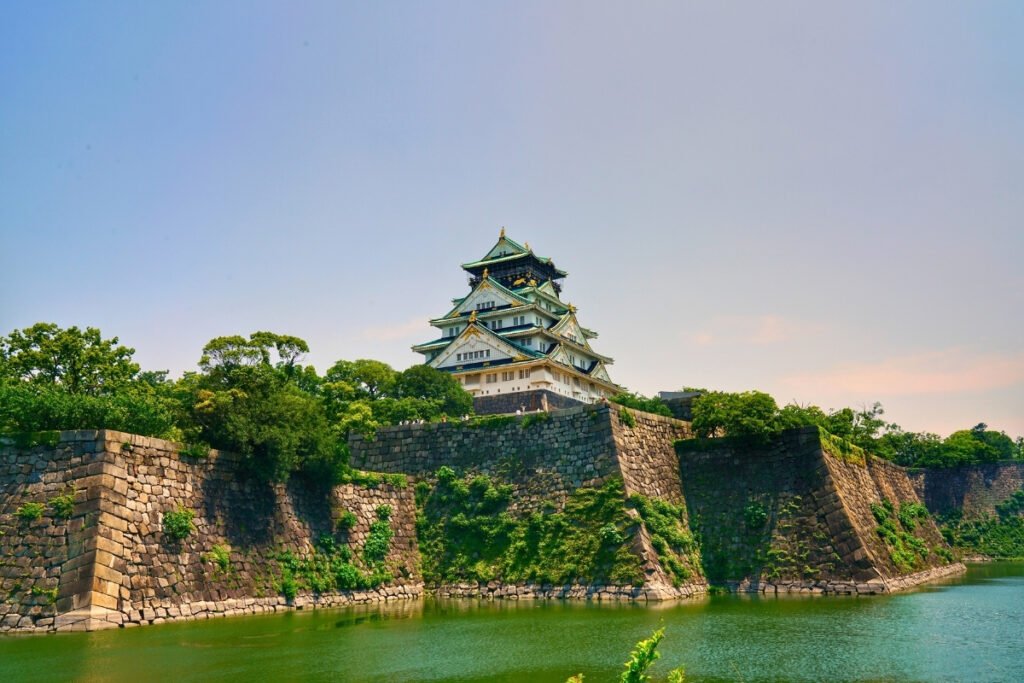
They’re enormous. Some of the granite blocks weigh over 100 tons. Stand beside one, and you’ll feel very small, very quickly. What’s remarkable isn’t just their size, but their precision. The stones were cut and fitted together without modern machinery, creating sloped defensive walls designed to deflect attackers and make climbing nearly impossible.
Even today, they’re among the largest castle stone walls in Japan.
Then there are the moats — wide, layered, and strategic. Osaka Castle was designed with multiple rings of defense. Outer moat. Inner moat. Massive gates positioned at angles to slow invading forces. The layout forced attackers to expose themselves repeatedly before reaching the main keep.
This wasn’t decorative architecture. It was battlefield engineering.
And yet, once you lift your eyes toward the main tower — the tenshu — everything changes.
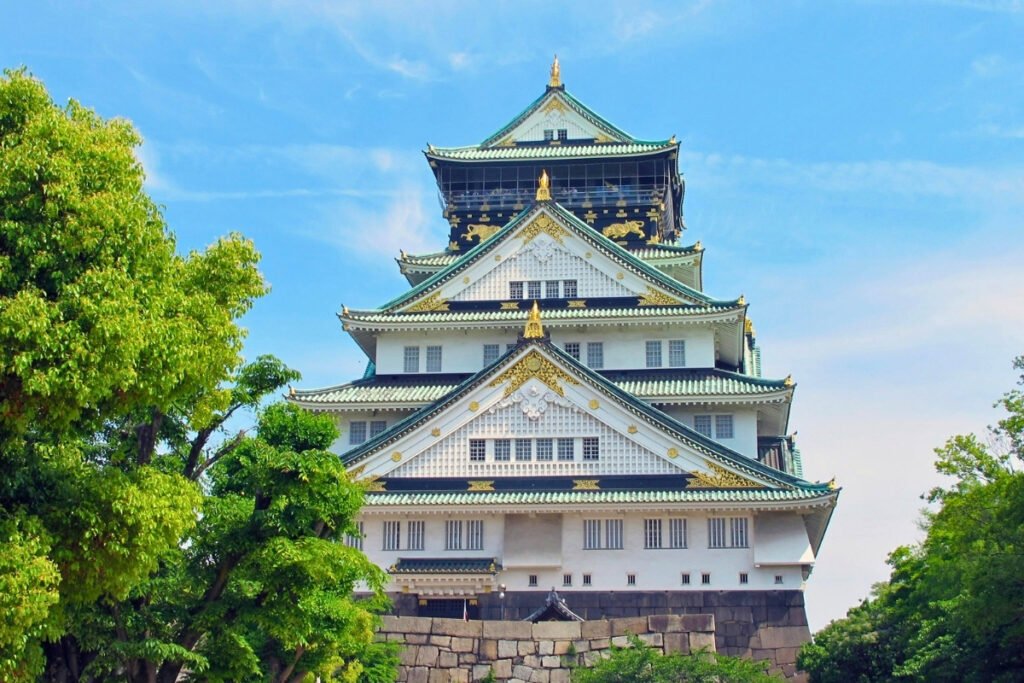
White plaster walls. Green-tiled roofs sweeping upward in elegant curves. Gold leaf accents catching the light. The contrast between brute-force stone foundations and refined ornamentation is dramatic. Osaka Castle balances power with theatrical flair.
Look closely at the rooflines, and you’ll see golden shachihoko — mythical tiger-headed fish believed to protect buildings from fire. They gleam in the sun and are visible even from a distance. During Hideyoshi’s era, the castle reportedly shimmered with even more gold detailing than today’s reconstruction. It was meant to broadcast wealth and authority.
The current main tower rises eight stories above its stone base. From the outside, it appears to be five tiers, but the interior levels don’t align perfectly with the exterior rooflines — a clever design feature common in Azuchi–Momoyama period castles.
Step inside, and the atmosphere shifts again.
Unlike castles such as Himeji, where original wooden interiors remain, Osaka Castle functions as a modern museum. The interior was rebuilt in reinforced concrete in 1931 and later upgraded in 1997. You’ll find elevators, climate-controlled exhibit halls, and multimedia displays.
Some visitors are surprised by this. If you’re expecting creaking wooden beams and narrow staircases, this isn’t that experience.
But what you gain instead is accessibility and context.
The Osaka Castle museum walks you through the life of Toyotomi Hideyoshi, the Siege of Osaka, and the broader unification of Japan. Armor replicas, historical documents, folding screen paintings, miniature battlefield dioramas — it’s immersive in a different way.
If you enjoy understanding what you’re looking at, rather than simply photographing it, the museum adds depth to your visit.
Climb all the way to the top — and you should — and you’ll reach the observation deck.
This is where history meets modern Osaka in one sweeping view.
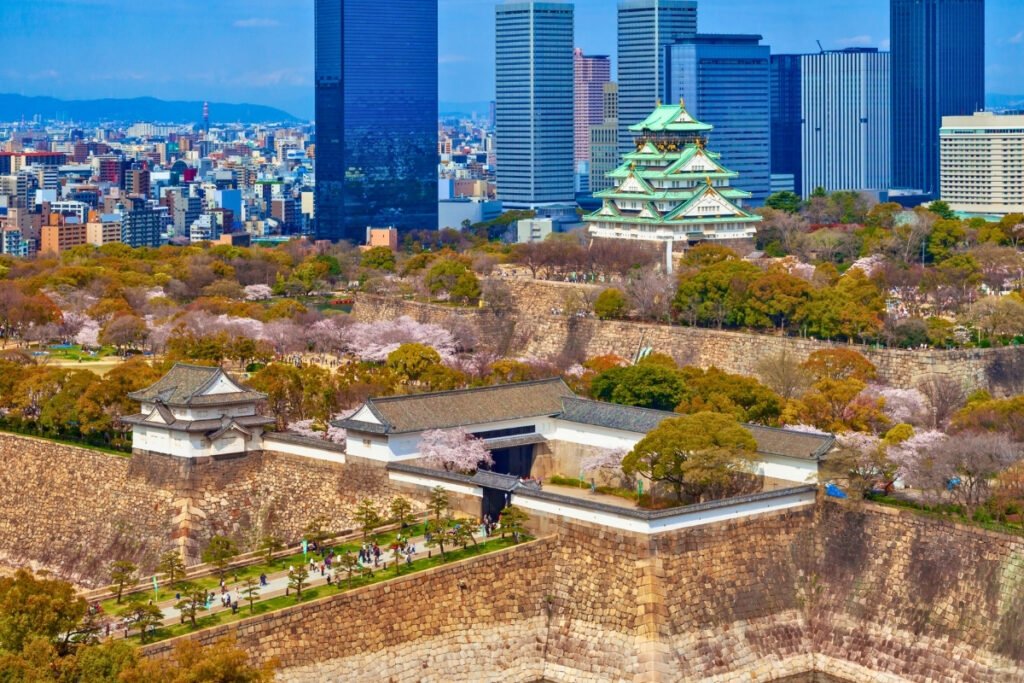
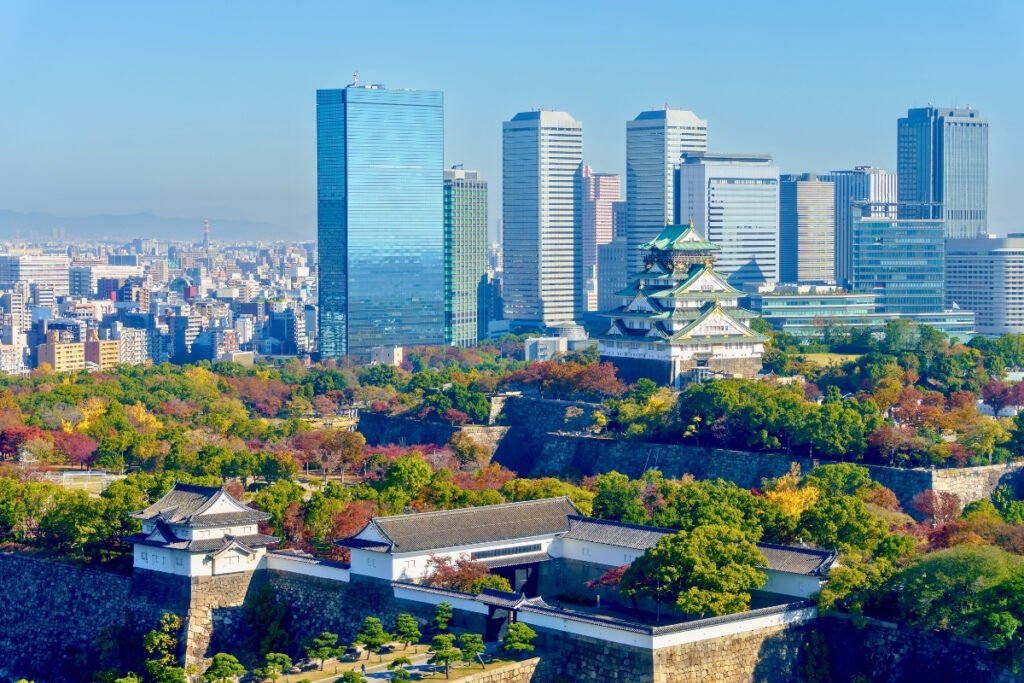
Skyscrapers stretch across the skyline. The Yodo River snakes through the city. On clear days, you can see far into the Kansai region. It’s one of the best panoramic viewpoints in Osaka. And the contrast is striking. A 16th-century symbol of samurai power rising above a 21st-century metropolis.
It’s almost poetic.
Outside the main keep, don’t rush past the yagura (turrets) and gates. Several original structures survive, including the Otemon Gate and important turret buildings designated as Important Cultural Properties. These details often go unnoticed, but they add authenticity to the experience.
One of the most underrated design elements is space.
Osaka Castle Park surrounds the fortress with wide lawns, groves of plum and cherry trees, and open pathways. Unlike some castles where the setting feels tight or urban, Osaka Castle has breathing room. The structure commands attention because it’s given room to stand alone.
And that’s intentional.
Castles were meant to dominate the landscape. Osaka Castle still does.
Stand near the inner moat and look at the reflection of the main tower in the water. Notice how the gold accents shimmer differently depending on the time of day. Early morning light softens the white walls. Late afternoon gives the green roofs a richer tone.
If you’re into photography, this place rewards patience.
Osaka Castle may not be entirely original wood and stone like some Japanese castles, but architecturally, it captures the drama of the Azuchi–Momoyama period better than almost anywhere else. Bold. Decorative. Strategic. Symbolic.
It tells you exactly what it was built to say.
Power lives here.
Visiting Osaka Castle: What You Need to Know Before You Go
You can admire Osaka Castle from a distance. Many people do.
But to really experience it, you need to walk the moats, pass through the gates, and climb to the top. Here’s how to do it right.
🛣️ How to Get There
Osaka Castle sits in the heart of the city, and getting there is straightforward — especially if you’re using Japan’s efficient rail system.
The most convenient stations are:
- Osakajokoen Station (JR Loop Line) – about a 10-minute walk
- Morinomiya Station (JR and Osaka Metro) – about 10–15 minutes
- Tanimachiyonchome Station (Osaka Metro) – about 15–20 minutes
If you’re staying near Namba or Dotonbori, expect roughly 20–30 minutes total travel time, including walking. From Kyoto, it’s about an hour door-to-door.
One thing to keep in mind: the station isn’t right at the castle entrance. You’ll still need to walk through Osaka Castle Park. Personally, I think that’s part of the experience. The gradual reveal — crossing wide paths, seeing the moat appear — builds anticipation.
Wear comfortable shoes. The grounds are large.
🎟️ Entry & Tickets
Here’s the good news: Osaka Castle Park is completely free.
You can walk the outer grounds, photograph the tower, explore the moats, and picnic without paying anything.
To enter the main tower museum, there is an admission fee. Tickets are purchased on-site at the entrance. During peak seasons, lines can form — especially in cherry blossom season and during weekends. For the most up-to-date information on opening times and current ticket prices, check the official page for the castle. It’s updated regularly and gives you a clear picture of what to expect before you arrive.
Inside, you’ll find multiple exhibit floors detailing:
- Toyotomi Hideyoshi’s life
- The Siege of Osaka
- Samurai armor and artifacts
- Historical maps and battle screens
If you enjoy history and context, it’s worth it. If you’re short on time and mainly interested in views and photography, you could skip the interior and still have a satisfying visit.
Expect to spend:
- 30–45 minutes exploring the grounds only
- 1.5–2 hours, including the museum
📅 Best Time to Visit Osaka Castle
Timing makes a huge difference here.
Cherry Blossom Season (Late March–Early April) 🌸
This is peak Osaka Castle magic.
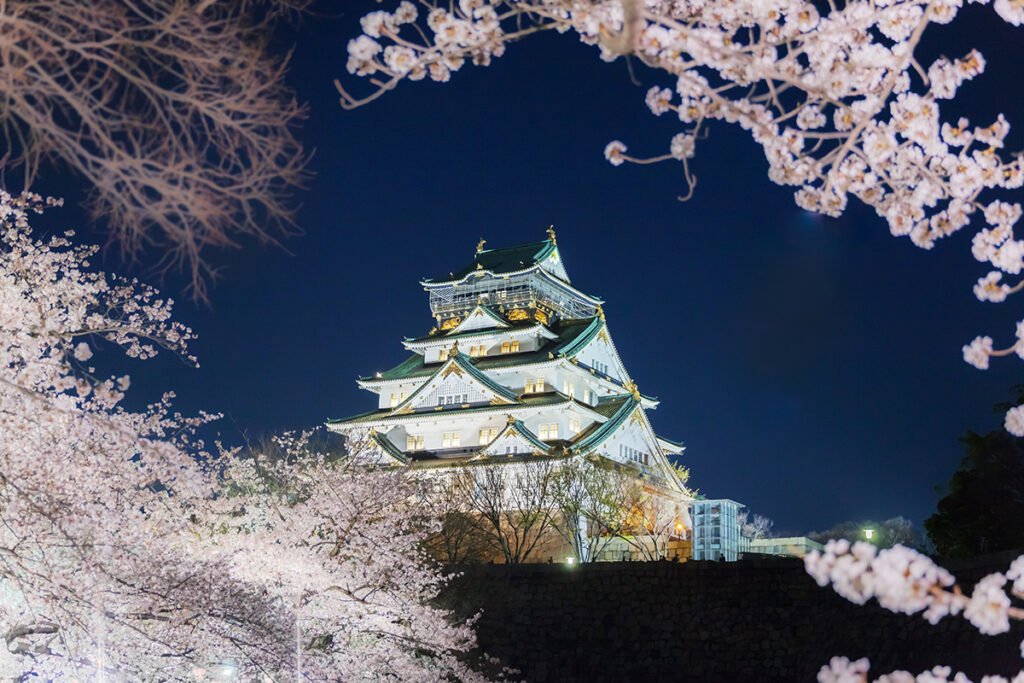
Thousands of cherry trees bloom throughout Osaka Castle Park, especially in Nishinomaru Garden. The white-and-pink blossoms framing the castle tower create one of Japan’s most iconic spring scenes.
But here’s the trade-off: it gets crowded. Very crowded.
If you visit during sakura season:
- Arrive before 9 AM
- Visit on a weekday if possible
- Be patient with museum lines
Still, it’s worth it. The atmosphere is festive. Locals picnic under the trees. Street vendors appear. It feels alive.
Autumn (November) 🍁
If you prefer fewer crowds and rich colors, autumn might be your sweet spot. The maple trees turn deep red and gold, and the cooler weather makes walking the grounds more comfortable.
Summer ☀️
Hot. Humid. Osaka summers can be intense. If you go in July or August:
- Visit early morning or near sunset
- Bring water
- Expect fewer blossoms but lush greenery
Winter ❄️
Quiet. Crisp air. Fewer tourists. The castle looks striking against a clear winter sky. You won’t get blossoms, but you’ll get space.
🕰️ When During the Day Is Best?
Early morning wins.
Arrive right when the grounds open. The light is soft. Tour groups haven’t arrived yet. You can photograph the main tower reflected in the moat without dozens of people in your frame.
Late afternoon is also beautiful, especially if you want warmer tones in your photos.
Midday? That’s peak tour bus time.
♿ Accessibility & Practical Tips
Osaka Castle’s interior is more accessible than many traditional Japanese castles because of its modern reconstruction.
There is:
- An elevator (to most floors)
- Wide exhibit spaces
- Restroom facilities inside
That said, the final level to the observation deck requires stairs. If mobility is a concern, check current accessibility details before your visit.
A few more tips:
- Bring cash or a contactless card for tickets and vending machines.
- Plan for walking. The park is larger than it looks on a map.
- Use the restrooms near the entrance before climbing the tower.
- Check weather forecasts. Clear days make the observation deck much more rewarding.
📸 Best Photo Spots
If you’re chasing the perfect Osaka Castle shot, here are a few prime angles:
- Across the Inner Moat (Otemon Gate side)
Classic reflection shot. Especially good in the morning. - Nishinomaru Garden
Best for cherry blossoms framing the castle. - From the Elevated Stone Walls
Capture the layered moats and skyline together. - Observation Deck
Wide skyline views with Osaka stretching in every direction.

And here’s a small detail many people miss: walk a little farther than the first obvious viewpoint. Most visitors stop at the first clear view. If you continue around the moat, you’ll often find a quieter angle.
How Long Should You Spend Here?
If Osaka Castle is one stop in a busy Kansai itinerary, plan for about 2 hours.
If you’re visiting during cherry blossom season or pairing it with the Osaka Museum of History next door, give yourself half a day.
This isn’t a quick “snap a photo and leave” kind of landmark. It rewards wandering.
Is Osaka Castle Worth Visiting?
That depends on what you’re looking for.
If you want untouched medieval interiors, you may prefer Himeji Castle.
If you want a powerful symbol of Japan’s unification, massive stone walls, sweeping moats, and one of the best skyline viewpoints in Osaka — this is your place.
It’s dramatic. It’s layered. It’s easy to access. And it offers something in every season.
More than anything, Osaka Castle gives you contrast.
Ancient ambition rising in the middle of a modern city. Samurai history framed by skyscrapers. Cherry blossoms floating above 16th-century stone.
It’s hard not to pause for a moment when you see it.
And that pause — that mix of scale, beauty, and history — is what makes the visit memorable.
Osaka Castle Park: More Than Just a Backdrop
It’s easy to think of Osaka Castle Park as just the space around the tower.
That would be a mistake.
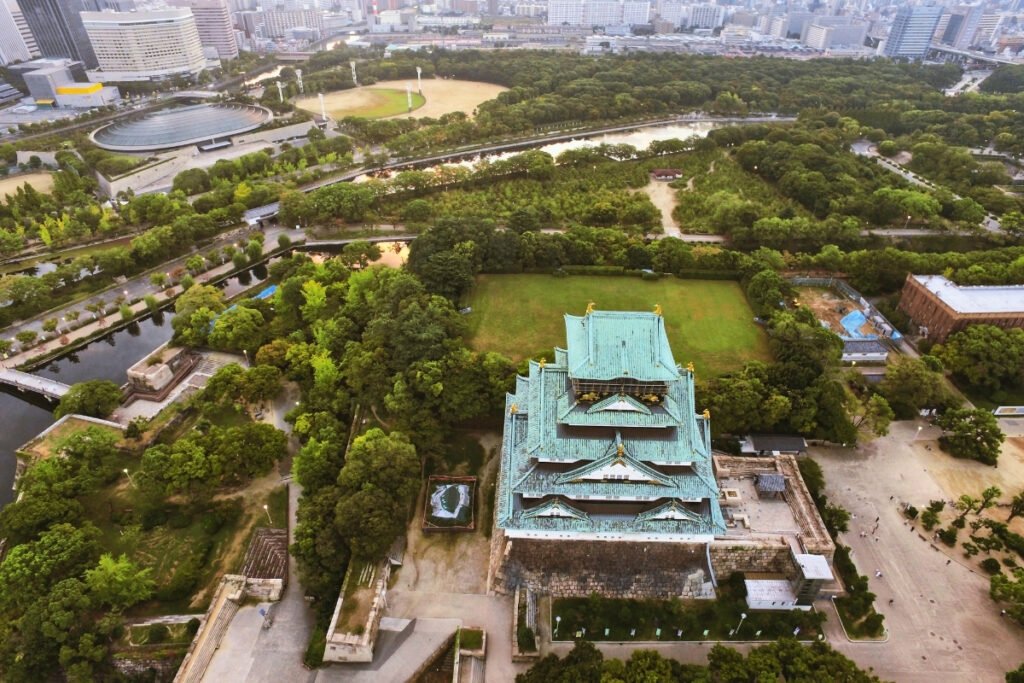
The park itself covers roughly 100 hectares, and it feels like a small world wrapped around the fortress. Wide lawns. Quiet wooded paths. Plum groves. Cherry trees lining the moats. Locals jogging in the early morning. Office workers eating lunch on benches with a castle view.
This isn’t just a tourist site. It’s part of daily life in Osaka.
One of the most beautiful areas is Nishinomaru Garden, located on the western side of the castle. It requires a small admission fee, but during cherry blossom season, it’s absolutely worth it. Around 300 cherry trees bloom here, perfectly framing the main tower. The open lawn makes it one of the best spots for hanami — Japan’s beloved cherry blossom picnics.
Come in early April, and you’ll see families spreading blankets under the trees. Friends sharing snacks. Laughter drifting across the grass. It’s festive without feeling chaotic.
If you visit in late winter, don’t miss the plum grove. Osaka Castle Park has over 1,000 plum trees that bloom earlier than cherry blossoms, usually in February. The air carries a faint sweet scent, and the crowds are thinner. It’s a quieter, softer version of spring.
Autumn brings another transformation. Maple and ginkgo trees turn deep red and gold, and the castle looks completely different against warm foliage. The reflection in the moat becomes richer, more dramatic.
Beyond the seasonal highlights, the park is simply pleasant to wander. You’ll pass stone walls at unexpected angles, small shrines tucked near pathways, and wide viewpoints where the castle suddenly appears framed between trees.
During festivals, food stalls sometimes pop up around the grounds. Think grilled snacks, sweet treats, and a lively but relaxed atmosphere. It adds a layer of energy without overwhelming the setting.
If you’re planning your visit, give yourself time to explore the park — not just the main tower.
Sometimes the best moment isn’t at the top of the castle.
It’s sitting on a bench, looking up at it from below.
Osaka Castle Museum: Is It Worth Going Inside?
From the outside, Osaka Castle feels purely medieval.
Inside, it’s something different.
The current interior functions as a multi-level history museum, and it’s very much a modern experience. Elevators. Well-lit exhibition rooms. Interactive displays. Climate-controlled galleries. If you’re expecting dark wooden corridors and creaking floors, adjust your expectations before you enter.
So — is it worth it?
If you’re curious about samurai history and want context beyond photos, yes.
The lower floors focus heavily on Toyotomi Hideyoshi. You’ll see detailed timelines of his rise from humble origins to national power, along with folding screen paintings depicting key battles. Some of these screens are especially fascinating — they show scenes from the Siege of Osaka in remarkable detail, almost like 16th-century storyboards.
There are also replicas of armor, weapons, and miniature battlefield models that help visualize how the castle’s defenses worked. For visitors unfamiliar with the Sengoku period, these exhibits make the architecture outside feel more meaningful.
Upper floors move toward the Tokugawa takeover and the castle’s later history, including its destruction and reconstruction.
The highlight for many visitors isn’t an exhibit — it’s the top floor.
The observation deck offers one of the best panoramic views in Osaka. On a clear day, you can trace the curve of the Yodo River and see the city stretching far into the distance. It’s a powerful contrast: a symbol of feudal Japan overlooking a modern skyline.
Would children enjoy it? Probably, especially the models and visual displays. But it’s not an interactive theme park-style museum. It’s educational and relatively straightforward.
If you’re short on time, you could skip the interior and still enjoy Osaka Castle. But if you want a fuller understanding of why this landmark matters, the museum adds depth.
Think of it this way: the outside impresses you.
The inside explains it.
Osaka Castle at Night: A Different Kind of Drama
Most visitors see Osaka Castle in daylight.
Fewer come back after dark.
And that’s a missed opportunity.
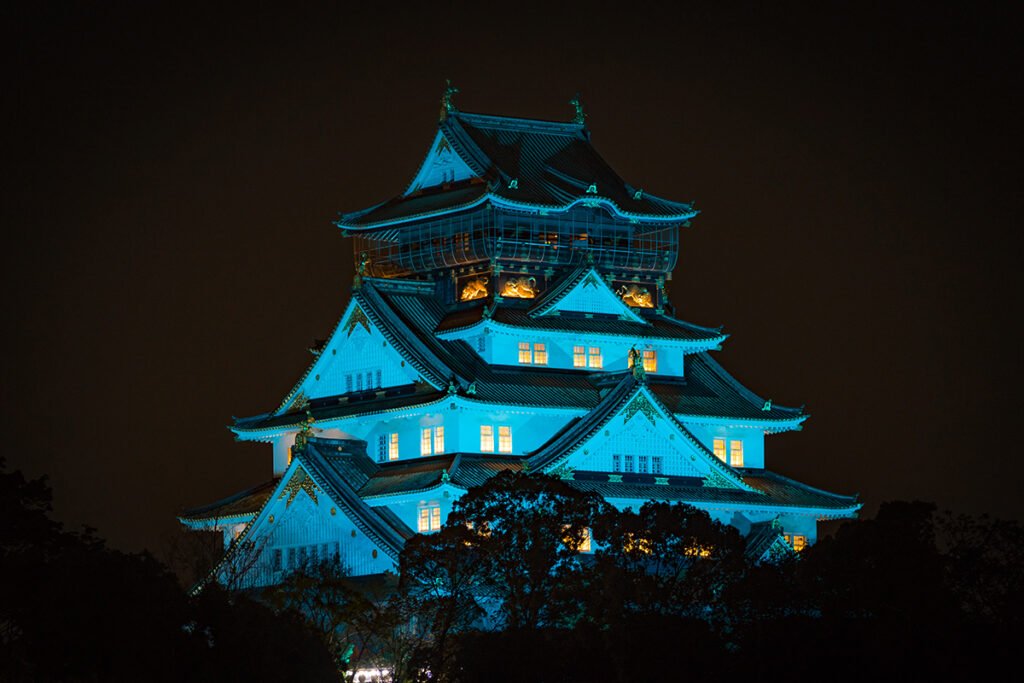
As evening settles over the city, the crowds thin. The tour groups disappear. The air cools. Then the illumination begins.
The main tower is softly lit from below, highlighting the white walls and green rooflines against the dark sky. The gold accents catch the light differently at night — subtler, warmer, almost glowing instead of shining.
Walk toward the inner moat and pause.
The reflection in the water is often clearer after sunset. On still evenings, the castle appears almost doubled — tower above, tower below. It feels quieter. More atmospheric. Less like a landmark and more like a stage set.
You won’t find loud music or festival energy here at night (unless there’s a special event). Instead, there’s a calm that contrasts beautifully with Osaka’s neon-lit districts like Dotonbori or Namba.
If you’re already exploring central Osaka in the evening, it’s easy to swing by. The park remains accessible, though the main tower museum closes earlier in the day, so plan accordingly if you want to go inside.
For photographers, this is prime time. Bring a tripod if you have one. Position yourself across the moat for a symmetrical composition. Or step back to include a slice of the modern skyline glowing in the distance.
The castle feels less like a daytime attraction and more like a symbol at night — steady, illuminated, watching over the city.
Is it worth returning after dark?
If you’re nearby, absolutely.
It’s the same structure.
But it tells a slightly different story.
Nearby Attractions: What to Pair with Osaka Castle
Osaka Castle rarely stands alone on a travel itinerary. The good news? You’re surrounded by some of the city’s most interesting districts and landmarks.
Here’s how to build a half-day or full-day plan around it.
🏛️ Osaka Museum of History
Right across from the castle grounds, this museum is often overlooked — and that’s a shame. It offers a layered look at Osaka’s evolution from ancient capital to modern metropolis. The upper floors provide excellent views back toward Osaka Castle, giving you a new perspective on the fortress within the urban landscape. If you enjoy context and storytelling, it pairs naturally with the castle visit.
🍢 Kuromon Market
About 15–20 minutes away by metro, Kuromon Market is where Osaka’s nickname as “Japan’s Kitchen” comes alive. Grilled seafood skewers. Fresh fruit. Takoyaki sizzling on hot plates. After a history-heavy morning, this is the perfect sensory shift. Eat standing up. Try something unfamiliar. Lean into the city’s food culture.
🌆 Dotonbori
If Osaka Castle represents samurai ambition, Dotonbori represents Osaka’s personality today. Neon signs, giant mechanical crabs, crowds flowing along the canal. It’s lively, loud, and unmistakably modern. Visit in the late afternoon or evening to see it at its brightest.
🛕 Shitennoji Temple
Founded in 593, Shitennoji is considered one of Japan’s oldest Buddhist temples. Its peaceful courtyard and pagoda provide a quieter counterpoint to Osaka Castle’s dramatic scale. It’s a good stop if you want something more spiritual and less fortified.
🌉 Umeda Sky Building
For another dramatic city view, head to the Umeda Sky Building’s Floating Garden Observatory. The perspective is entirely different — urban, vertical, contemporary. Seeing Osaka from both the castle tower and a modern skyscraper offers a striking contrast.
Osaka Castle anchors you in the past.
These nearby spots pull you into Osaka’s present.
Frequently Asked Questions About Osaka Castle
Is Osaka Castle worth visiting?
Yes — especially if you’re interested in samurai history, large-scale Japanese castle architecture, or seasonal scenery like cherry blossoms. Even if you skip the museum interior, the grounds and stone walls alone make it one of Osaka’s most impressive landmarks.
How long should I spend at Osaka Castle?
Plan for about 2 hours if you’re exploring the park and visiting the museum. If you’re coming during cherry blossom season or pairing it with nearby attractions, allow half a day.
Is Osaka Castle original?
The stone foundations, moats, and several gates are original or date back centuries. However, the current main tower is a 1931 reconstruction, renovated in 1997, and functions as a modern museum inside.
Can you go inside Osaka Castle?
Yes. The main tower houses the Osaka Castle Museum, which includes historical exhibits and an observation deck at the top. Admission is required to enter the tower, but the surrounding park is free.
When is cherry blossom season at Osaka Castle?
Cherry blossoms typically bloom from late March to early April. Exact timing varies each year depending on weather. Nishinomaru Garden is one of the best viewing spots in Osaka.
Is Osaka Castle free?
Osaka Castle Park is free to enter. There is an admission fee to access the main tower museum and Nishinomaru Garden.
What is the best time of day to visit Osaka Castle?
Early morning is ideal for fewer crowds and softer light. Late afternoon is also beautiful for photography. Midday tends to be the busiest.
How do I get to Osaka Castle?
The easiest access is via the JR Loop Line to Osakajokoen Station. Several Osaka Metro stations are also within walking distance, including Morinomiya and Tanimachiyonchome.
Is Osaka Castle good for kids?
Yes. The park offers open space to explore, and the museum includes visual displays and models that help bring the history to life. It’s an easy, family-friendly stop in Osaka.
What should I pair with a visit to Osaka Castle?
Popular nearby options include Osaka Museum of History, Kuromon Market, Dotonbori, and Umeda Sky Building. Many visitors combine the castle with Osaka’s food districts for a balanced day.
Final Thoughts: A Fortress That Still Commands Attention
Osaka Castle isn’t the oldest castle in Japan. It isn’t entirely original wood and stone. And yet, it leaves a strong impression.
Maybe it’s the scale of the granite walls. Maybe it’s the gold details catching the light. Or maybe it’s the story — a warlord’s ambition, a nation’s unification, a fortress that burned and rose again more than once.
What makes Osaka Castle memorable is contrast. Samurai history set against skyscrapers. Cherry blossoms drifting across ancient moats. A 16th-century power statement standing in the middle of one of Japan’s most modern cities.
If you’re exploring Kansai, pair this visit with Himeji Castle for a look at Japan’s best-preserved original fortress. Or dive deeper into the country’s castle culture with a “Best Castles in Japan” itinerary. Each stronghold tells a different chapter of the same story.
But start here.
Walk the moats. Climb the tower. Stand on the observation deck and look out over Osaka.
Then decide for yourself what kind of legacy ambition leaves behind.
💬 If you’ve already walked the moats of Osaka Castle, your experience may not look exactly like someone else’s — and that’s part of what makes it memorable. Maybe you caught the cherry blossoms at peak bloom. Maybe you stood on the observation deck just before sunset. Maybe the stone walls impressed you more than the tower itself. Whatever stood out, that moment is yours. Feel free to share it.
👉 And if Osaka Castle sparked something — a curiosity about samurai history, fortress design, or Japan’s turbulent unification — don’t stop here. Pair it with Himeji Castle: A Timeless Icon of Japan’s Samurai Age to see Japan’s most perfectly preserved original keep. Explore Matsumoto Castle Travel Guide: Samurai History & Visiting Tips for a darker, more atmospheric stronghold set against the Japanese Alps. Or zoom out entirely with The 25 Most Famous Castles in the World: Iconic Fortresses You Must See and discover how Osaka fits into the global story of power, ambition, and stone.
🏯✨ Thanks for reading. If this guide helped you plan your visit, stay with us for more in-depth castle stories and practical travel advice. There’s a whole world of fortresses still waiting — and each one has something different to say. You can also follow us, CastleQuest Chronicles, on Instagram, Facebook, Pinterest, YouTube, TikTok, and X.