You see it before you quite believe it.
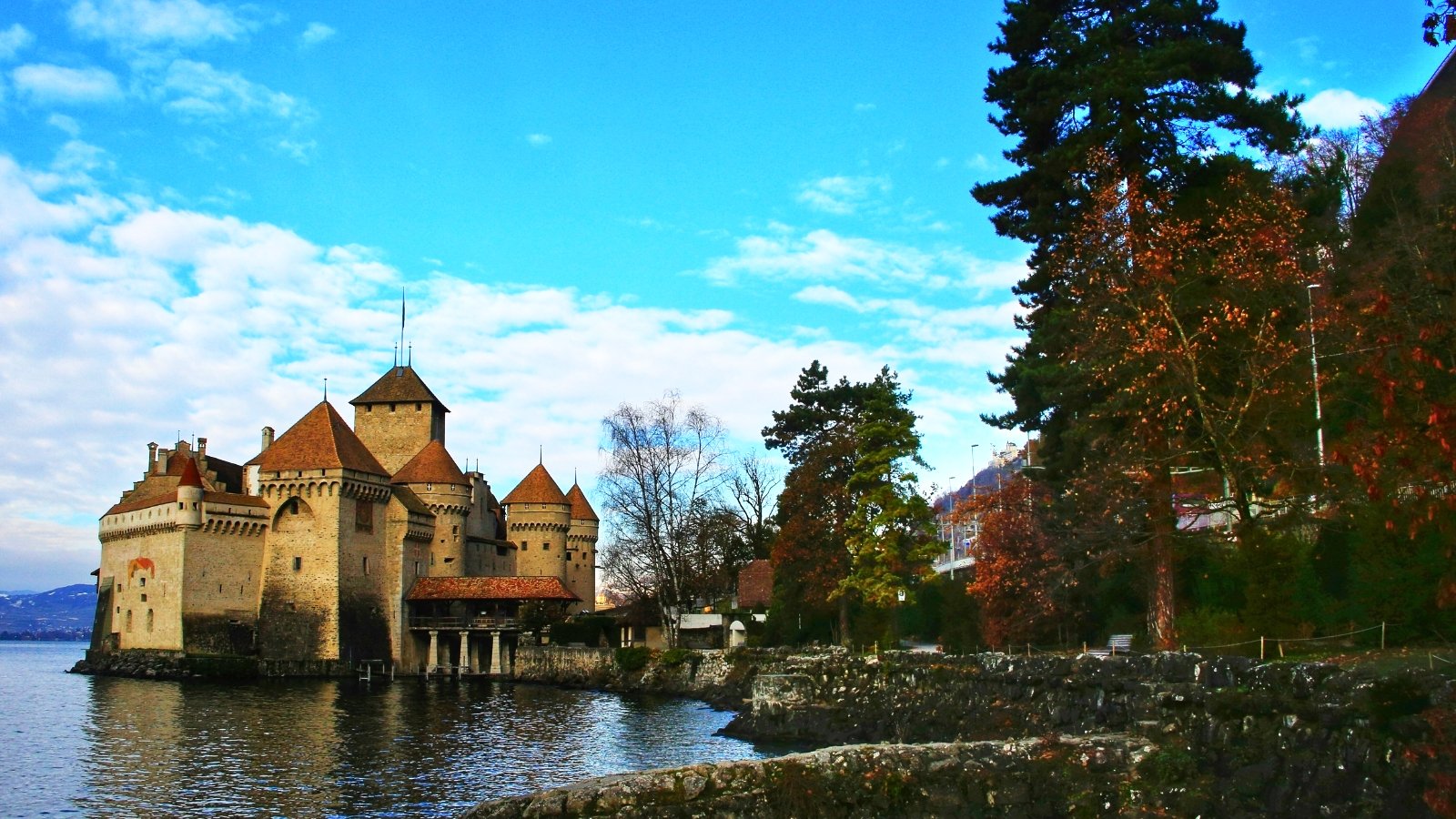
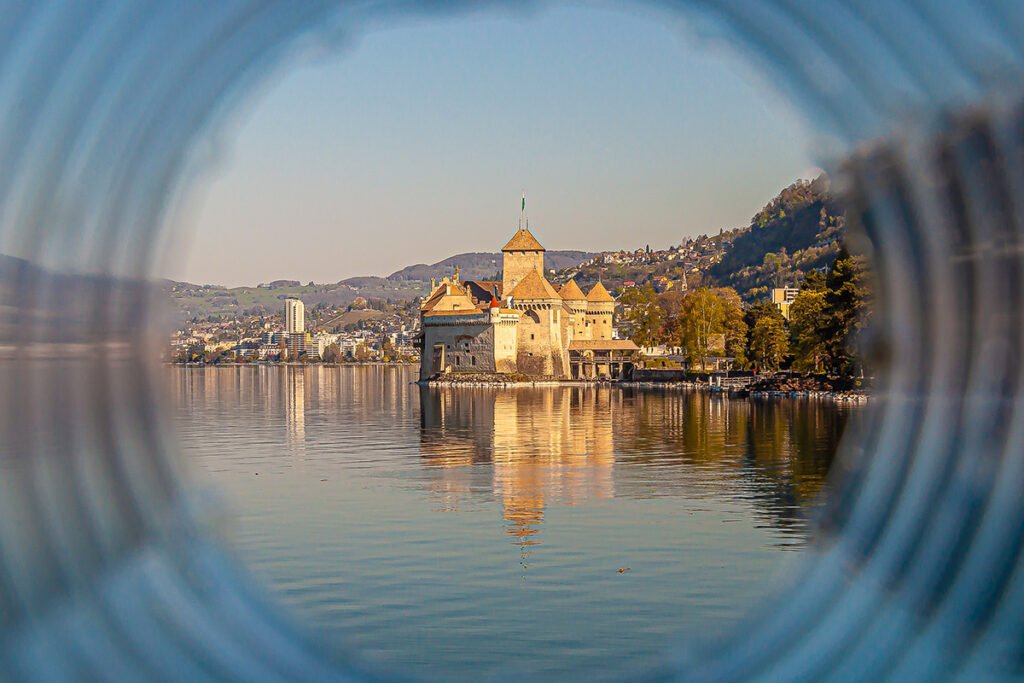
A pale stone castle rising straight out of Lake Geneva. Snow-dusted Alps in the distance. Vineyards climbing the hills behind it. And water — always the water — lapping softly against medieval walls that have stood here for nearly a thousand years.
This is Chillon Castle in Switzerland. And yes, it really does look like something lifted from a storybook.
But Chillon isn’t fantasy. It’s strategy. It’s politics. It’s imprisonment. It’s poetry carved into stone.
For centuries, this fortress guarded one of the most important Alpine trade routes between northern Europe and Italy. Whoever controlled Chillon controlled movement, money, and military access through the region. The Counts of Savoy understood that. So did the Bernese, who later took it over. Even today, standing in its shadow, you feel how deliberate its location is — protected on all sides by water and mountains.
Then there’s the darker chapter.
In the castle’s vaulted dungeon, François Bonivard was chained for years. Centuries later, Lord Byron visited and was so moved by the story that he wrote The Prisoner of Chillon, turning this Swiss fortress into a symbol of endurance and resistance. Byron even carved his name into one of the pillars — and you can still see it.
That’s what makes Chillon Castle, Switzerland’s most iconic lakeside fortress. It’s beautiful, yes. But it’s also layered with real history you can walk through room by room.
Today, it’s one of the most visited historic sites in the country — and for good reason. Whether you’re staying in nearby Montreux, exploring the Lavaux vineyards, or touring castles in Switzerland, a visit to Chillon feels essential.
And once you step across its wooden drawbridge, you’ll understand why.

Quick Facts About Chillon Castle
📍 Location: Veytaux, on the shores of Lake Geneva, near Montreux, Switzerland
🏗️ Construction Period: Earliest structures date to the 11th century (with foundations likely earlier); major expansions under the Counts of Savoy in the 13th century
🏰 Architectural Style: Medieval fortified castle with Savoyard Gothic elements
🎭 Famous For: Its dramatic lakeside setting, medieval dungeons, and Lord Byron’s poem The Prisoner of Chillon
👑 Notable Figures: The Counts of Savoy; François Bonivard (political prisoner); Lord Byron
🏆 UNESCO Status: While Chillon Castle itself is not individually listed, it sits near the Lavaux Vineyard Terraces, a UNESCO World Heritage Site
🌐 Official Website: chillon.ch
Compact. Strategic. Unmistakable.
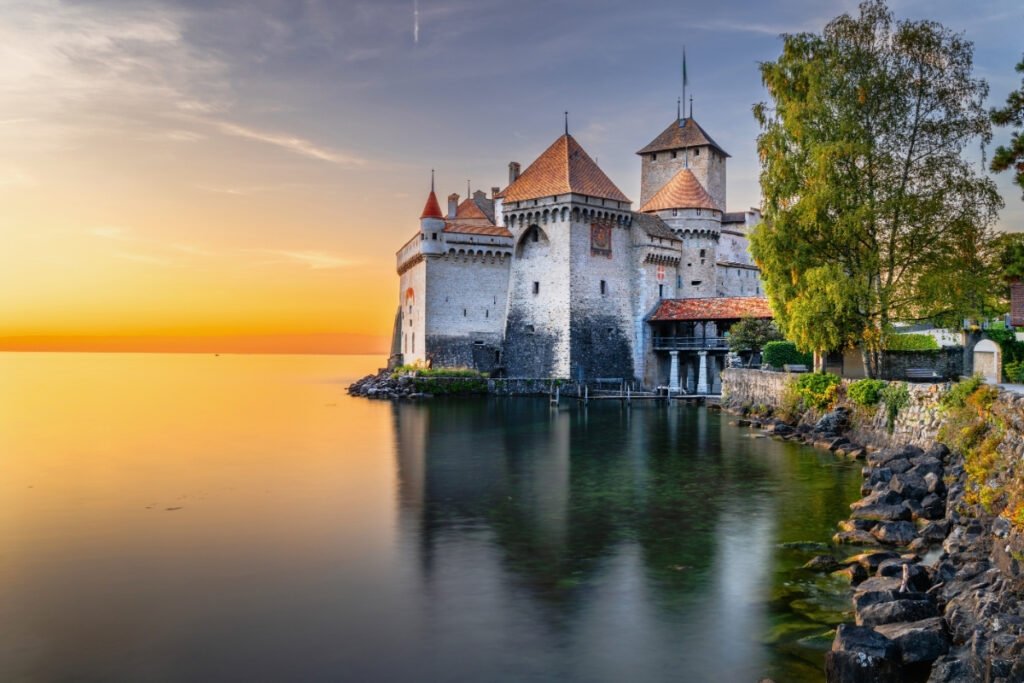
Unlike hilltop fortresses that dominate from above, Chillon Castle rises directly from the water, built on a rocky islet along the eastern edge of Lake Geneva. Its position wasn’t chosen for beauty — though that’s now its trademark — but for control. Any army or merchant traveling between northern Europe and Italy once had to pass within sight of these walls.
Today, Chillon Castle remains one of the most visited historic landmarks in the country. And once you see that silhouette against the Alps, it’s easy to understand why.

History & Legends of Chillon Castle
Long before it became Switzerland’s most photographed lakeside landmark, this fortress was a calculated piece of power.
The rocky island it stands on wasn’t chosen for romance. It was chosen for control.
As early as Roman times, this narrow strip between the mountains and Lake Geneva was a strategic choke point. Anyone traveling along the route linking northern Europe to Italy had to pass here. Trade caravans. Pilgrims. Soldiers. Tax collectors. The location was perfect for monitoring — and taxing — movement.
The first substantial castle structures appeared in the 12th century, but it was under the Counts of Savoy in the 13th century that Chillon truly expanded. They transformed it into both a defensive fortress and an administrative center. Thick outer walls were reinforced. Towers were raised. Residential halls were refined. A chapel was added, its frescoes still faintly visible today.
The Savoy family used Chillon as a lakeside residence as much as a military outpost. Imagine the contrast: armored guards patrolling the battlements while noble guests dined in vaulted halls overlooking calm water. It was both a stronghold and a statement.
But not all who entered did so freely.
The Prison Years
Beneath the castle lies its most haunting space — the dungeon.
Supported by massive stone pillars and ribbed vaulting, the subterranean chambers feel more like a cathedral of confinement than a typical prison. Light filters in through narrow slits. The air stays cool and damp even in summer.
It was here that François Bonivard was imprisoned in the early 16th century.
Bonivard was a Genevan monk and political activist who opposed Savoyard control over Geneva. For his resistance, he was captured and chained to a pillar in Chillon’s dungeon. He remained imprisoned for several years — 1532-1536 — unable to walk beyond the limited circle allowed by his chain.
When the Bernese forces conquered the region in 1536, they liberated him.
His story might have faded into regional history. But three centuries later, a British poet changed that.
Byron’s Mark
In 1816, during a tour of Switzerland, Lord Byron visited the castle.
He descended into the dungeon. He saw the pillar where Bonivard had been chained. He was moved — deeply. Soon after, he wrote The Prisoner of Chillon, a dramatic monologue inspired by Bonivard’s suffering.
The poem was widely read across Europe. It transformed Chillon from a regional fortress into an international literary symbol of endurance and political resistance.
Byron even carved his name into one of the dungeon pillars. You can still see it today — scratched into the stone by a Romantic-era celebrity standing in the same place you can stand now.
That carving helped save the castle.
From Fortress to National Symbol
By the early 19th century, many medieval fortresses across Europe were falling into ruin. Chillon might have faced the same fate. But its growing fame — fueled by literature, art, and travel writing — inspired restoration rather than demolition.
Swiss historians and preservationists began careful conservation work in the late 1800s. Instead of heavily reconstructing it into a fantasy version of itself, they focused on maintaining structural authenticity. The goal was to preserve what remained, not reinvent it.
That decision is part of what makes visiting today so compelling. The stone you see in the dungeon. The wooden beams in the halls. The worn steps in spiral staircases. Much of it is genuinely medieval.
The Bernese Chapter
After the fall of Savoy control in 1536, the Bernese took over the castle. Under Bernese administration, Chillon’s role shifted. It became more of a government and storage site than a noble residence.
The Bernese added practical modifications — storage rooms, administrative spaces, defensive adjustments — but the castle gradually lost its political prominence as trade routes evolved.
By the time the canton of Vaud gained independence in 1798, the fortress was no longer strategically essential. Its survival became cultural rather than military.
A Castle in the Landscape
Throughout the 19th century, artists painted it. Travelers described it. Steamships began docking nearby. The rise of tourism around Montreux turned the castle into a highlight of the Swiss Riviera.
Unlike many castles perched high on hills, Chillon is approachable. Intimate. It feels connected to daily life rather than isolated from it.
And yet, when you step inside the dungeon, the atmosphere shifts.
The echoes are real. The shadows are real. The weight of history is real.
That balance — beauty above, confinement below — is what defines Chillon’s story. It was never just one thing. It was power and poetry. Residence and prison. Control and vulnerability.
Few castles in Switzerland offer such a layered history in such a compact footprint.
And when you leave the cool darkness of the dungeon and step back into sunlight reflecting off the lake, the contrast lingers.
That, more than anything, is why Chillon endures.
Architecture & Design: What Makes Chillon Castle Unique
At first glance, Chillon Castle looks almost delicate.
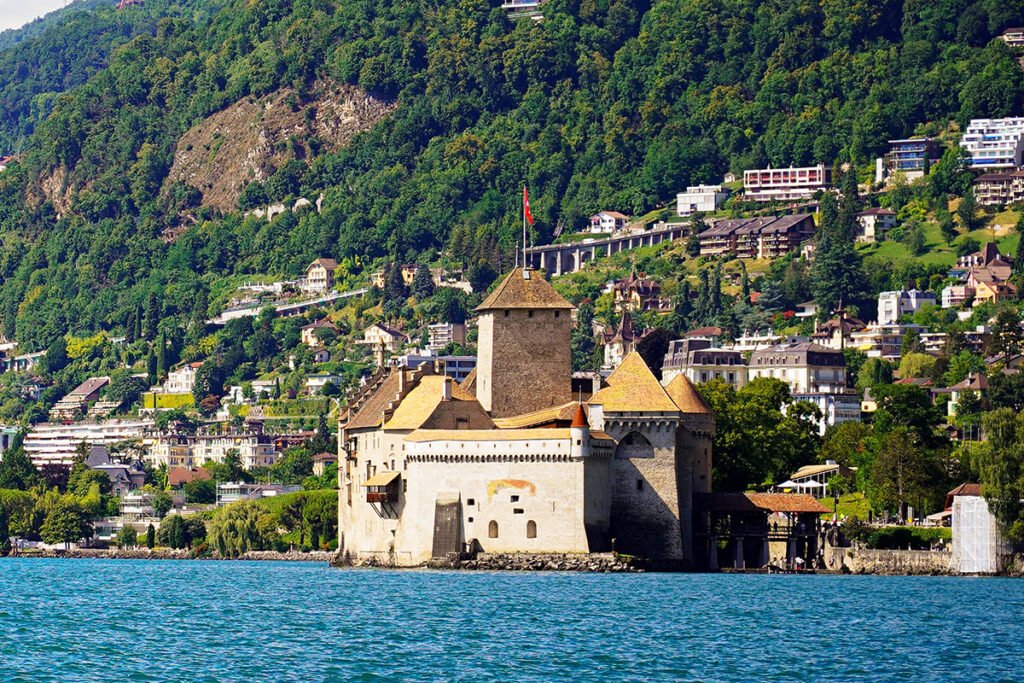
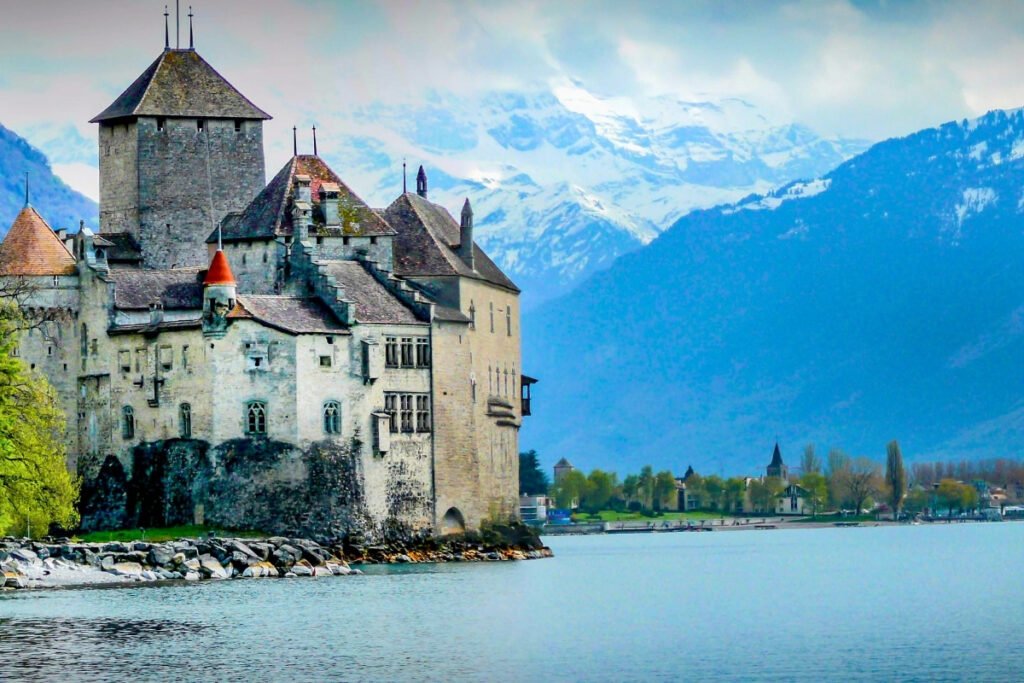
The pale stone. The red-tiled roofs. The towers reflected in the still water of Lake Geneva. It’s easy to forget this was built as a defensive machine.
But look closer.
You’ll notice how tightly everything is packed. Chillon isn’t sprawling like some hilltop fortresses. It’s compact. Purpose-built. Every wall, tower, and courtyard fits precisely onto the rocky islet beneath it.
That’s part of its architectural brilliance.
Built on Water
Unlike most medieval castles in Switzerland, Chillon rises directly from the lake. The natural rock foundation was incorporated into the structure itself. In some rooms, the bedrock is still visible, blending seamlessly into the walls.
Water served as a natural moat on nearly all sides. The only land access was controlled by a drawbridge. In the Middle Ages, that made the castle extraordinarily difficult to attack.
Instead of building up a mountain, the Counts of Savoy built outward and upward in layers — creating a tight cluster of about 25 buildings connected by narrow passages and staircases.
It feels almost like a medieval maze.
The Outer Walls and Towers
The first impression from outside is defensive strength. Thick curtain walls ring the complex. Arrow slits puncture the stone. Towers rise at intervals, offering elevated vantage points over both the lake and the mountain road.
Climb one of these towers today, and the strategic logic becomes obvious. You can see boats approaching from miles away. You can watch the narrow strip of land traffic had to pass through.
Control was visual long before it was physical.
The Courtyards: Light and Air
Once inside, the mood shifts.
Instead of dark corridors, you find open courtyards filled with light. Wooden galleries line upper levels. Stone staircases wind upward at sharp angles. The layout feels organic — built over centuries rather than designed in a single phase.
The main courtyard connects residential spaces with administrative halls. From here, you can access everything from noble apartments to service quarters.
And this is where Chillon feels surprisingly intimate.
Unlike enormous royal palaces, the scale here remains human. You’re not overwhelmed by vast halls. You move through rooms that feel lived in.
The Great Halls
The great halls are among the most striking interior spaces. Large wooden ceilings stretch overhead. Massive fireplaces dominate the walls. Windows frame the lake like paintings.
These rooms were used for banquets, meetings, and official functions during the Savoy period. Today, they retain a raw authenticity — stone walls left exposed, floors worn smooth by centuries of use.
Stand near the windows, and you understand something important: the views weren’t just beautiful. They were symbolic. Anyone dining here would have been reminded of the territory under Savoy control.
Architecture was messaging.
The Chapel
Tucked within the complex is one of Chillon’s most delicate features — the chapel.
Its 14th-century frescoes survived centuries of change, including the Protestant Bernese occupation that stripped many religious images from the region. When restoration efforts began in the 19th century, these paintings were carefully uncovered and preserved.
Look closely, and you’ll see medieval pigments still clinging to stone — saints, patterns, decorative motifs.
It’s a quiet space. Smaller than you expect. But deeply atmospheric.

The Dungeon
Then there’s the dungeon.
Architecturally, it may be the most impressive part of the entire castle.
Vaulted ceilings rise from thick stone pillars. The design resembles a Gothic crypt more than a prison. The ribbed arches distribute weight efficiently, allowing the space to feel open despite its underground location.
Light filters in through narrow openings near the waterline. On some days, reflections from the lake flicker faintly across the ceiling.
It’s beautiful. And unsettling.
Here, the architecture of defense meets the architecture of confinement.
Savoyard Gothic Influence
Chillon’s style is often described as Savoyard Gothic — a regional variation influenced by French Gothic elements but adapted to military needs.
You won’t find soaring cathedral spires. Instead, you see restrained ornamentation, practical defensive features, and carefully balanced proportions.
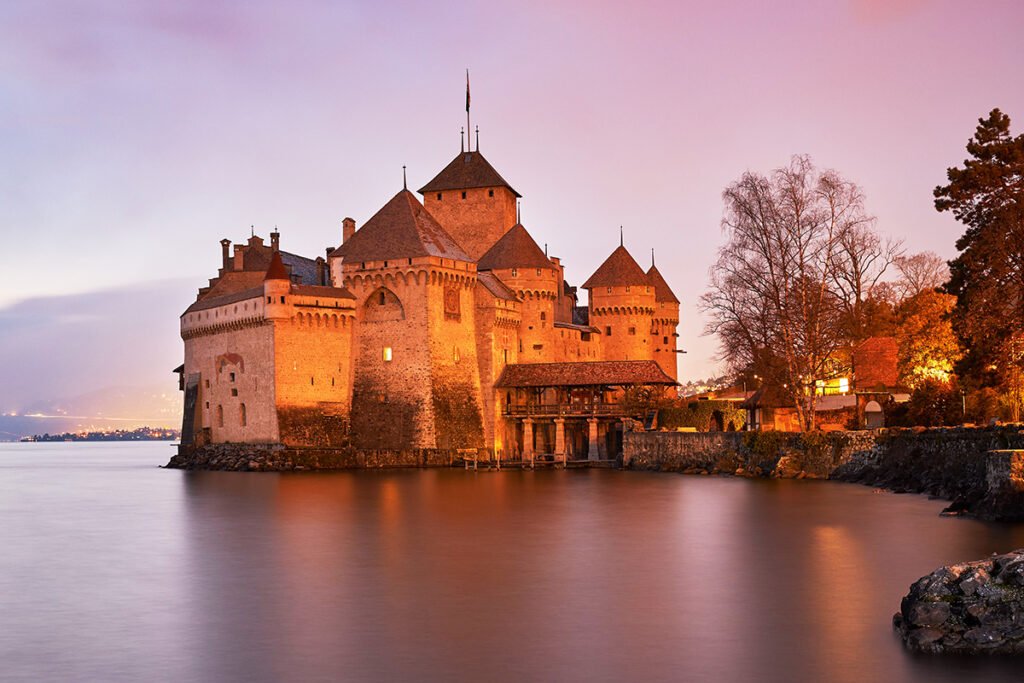
The castle’s silhouette — especially when viewed from the water — is one of its defining architectural achievements. The towers and roofs create a rhythm that feels almost storybook-like.
Yet nothing here was built for fantasy.
Every line had purpose.
A Living Structure
One of the reasons Chillon Castle in Switzerland stands out among castles in Switzerland is how intact it feels. Restoration work respected the original materials and layout. You don’t walk through theatrical reconstructions. You walk through layered history.
Stone from the 12th century. Timber beams from the 14th. Restorations from the 19th.
It’s all visible.
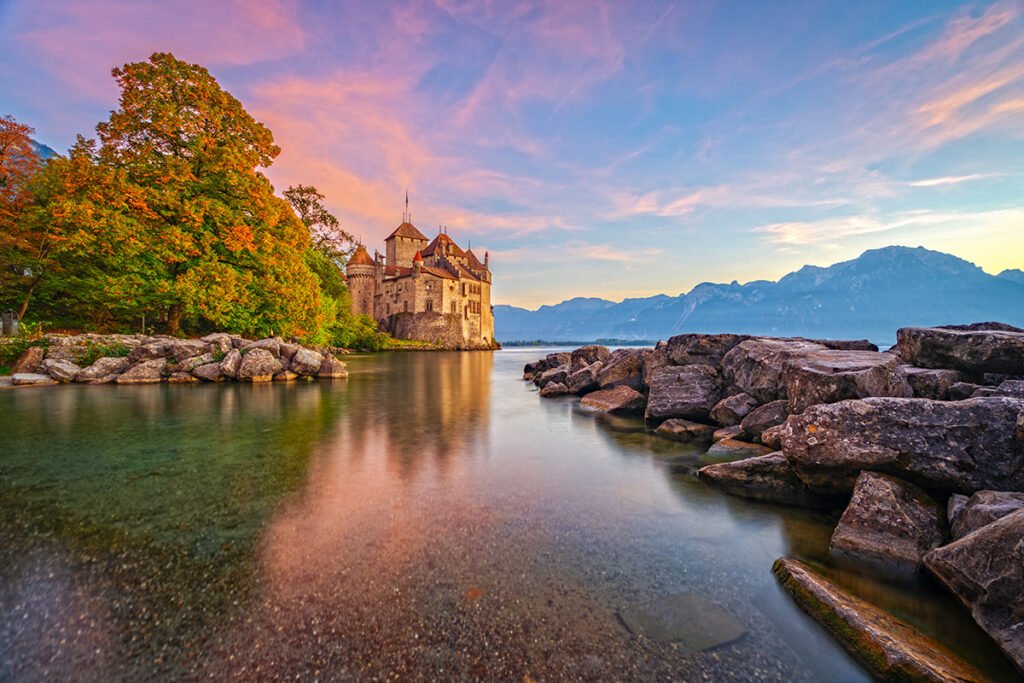
And when you step back outside and see the entire fortress mirrored in Lake Geneva, you realize something rare: this isn’t just a castle placed in a landscape.
It’s a castle fused with it.
Water, rock, mountain, and stone — all working together.
That harmony is what makes Chillon unforgettable.
Visiting Chillon Castle: Everything You Need to Know
You can admire Chillon Castle from the outside for free.
But to really understand it, you need to cross the bridge.
The good news? Visiting Chillon Castle is straightforward, scenic, and easy to combine with other highlights around Lake Geneva.
Let’s break it down clearly.
🛣️ How to Get to Chillon Castle
From Montreux
This is the most popular route — and the most beautiful.
Chillon Castle sits about 3 km (1.8 miles) from the center of Montreux. You can:
- Walk along the lakeside promenade (about 40–45 minutes)
- Cycle along the same scenic path
- Take a local bus (quick and inexpensive)
- Arrive by boat
The lakeside walk is worth doing at least one way. The path hugs Lake Geneva, with the Alps rising behind you and the castle gradually coming into view. It’s one of those approaches that builds anticipation perfectly.
From Geneva
Trains from Geneva to Montreux run frequently and take about one hour. From Montreux station, follow the options above.
From Lausanne
Lausanne is even closer — around 30 minutes by train.
By Boat
This is the most cinematic option.
Lake Geneva steamers operate seasonal routes between Geneva, Lausanne, Vevey, and Montreux. Watching the castle rise from the water as your boat approaches feels almost theatrical.
If you want photos of Chillon Castle from the best angle, this is the way to do it.
🎟️ Entry & Tours
Chillon Castle is open year-round, though hours vary slightly by season.
Typical ticket prices in 2026:
- Adults: 15 CHF
- Discounts available for children, students, and families
- Swiss Travel Pass holders often receive reduced entry fees
For Switzerland, it’s reasonably priced — especially considering how much access you get.
For the most up-to-date information on opening times and current ticket prices, check the official page for the castle. It’s updated regularly and gives you a clear picture of what to expect before you arrive.
You’re free to explore independently. The visit is self-guided, but there are:
- Informative panels throughout
- An optional audio guide (available in multiple languages)
- Occasional guided tours depending on the season
Plan for 1.5 to 2 hours minimum.
If you enjoy photography, architecture, or slower exploration, you could easily spend longer.
Unlike some heavily curated historic sites, Chillon gives you room to wander. You climb towers. You duck through narrow staircases. You explore hidden chambers.
It feels hands-on rather than museum-like.
📅 Best Time to Visit Chillon Castle
Timing matters here.
Because Chillon Castle in Switzerland is one of the country’s most visited historic sites, summer afternoons can get crowded — especially in July and August.
Best time of day?
Right at opening.
The first hour offers softer light, fewer tour groups, and quieter dungeons. It’s also the best moment for photography from the outer ramparts.
Best season?
May, June, September, and early October.
You’ll still get beautiful lake reflections and Alpine views, but without peak summer crowds.
Winter is quieter still — and surprisingly atmospheric. Snow on the mountains behind the castle creates a dramatic backdrop. Just check reduced seasonal hours in advance.
Photography Tips
If you’re serious about photography, here’s what works:
- Morning light illuminates the lakeside beautifully.
- Late afternoon casts warm tones on the stone walls.
- The best exterior viewpoint is from the lakeside path heading back toward Montreux.
- Boat approaches provide symmetrical, postcard-perfect angles.
Inside, photography is allowed without flash in most areas.
The dungeon, chapel, and towers all offer strong visual contrasts.
♿ Accessibility & Practical Considerations
Chillon Castle is medieval. That means:
- Narrow spiral staircases
- Uneven stone floors
- Limited elevator access
Some ground-level sections are accessible, but upper towers and certain rooms require climbing stairs.
Wear comfortable shoes. The stone can be slippery, especially in damp weather.
For families, it’s manageable and engaging. Children tend to love:
- The towers
- The drawbridge
- The dungeon spaces
There are restrooms and a small gift shop on site.
You’ll also find a café nearby for coffee or light snacks, though Montreux offers more extensive dining options.
How Long Should You Spend?
If you’re doing a quick stop while touring the best castles near Lake Geneva, 90 minutes works.
If you’re pairing it with:
- Lavaux vineyards
- Montreux exploration
- A lake cruise
Then allow half a day for the area.
Many visitors combine Chillon Castle with a relaxed lakeside lunch afterward.
That’s a smart move.
Combining Chillon Castle with Nearby Highlights
The castle fits easily into a larger Swiss Riviera itinerary.
You can:
- Walk from Montreux in the morning
- Tour the castle before lunch
- Continue to the Lavaux vineyards in the afternoon
Or reverse the order for sunset photos.
Because distances are short and public transport is efficient, this region works well without a car.
Is Chillon Castle Worth Visiting?
If you’re already in the region — absolutely.
If you’re planning a Switzerland itinerary and debating whether to include it — yes again.
Here’s why:
- It’s architecturally intact.
- It’s dramatically positioned.
- It’s layered with real history.
- It’s easy to access.
- It doesn’t require a full-day commitment.
Many castles in Switzerland are ruins or heavily restored fantasy structures.
Chillon strikes a rare balance. It feels authentic. Atmospheric. Connected to its landscape.
And that setting — water on one side, mountains on the other — makes it uniquely photogenic.
You’ll understand why it’s often considered the most iconic Lake Geneva castle.
A Small Insider Tip
Most visitors rush straight into the main entrance.
Instead, take five extra minutes to walk slightly past the castle along the lakeside path. Turn back and look at it from a slight angle rather than head-on.
That perspective reveals the layering of towers and walls far better.
It’s a small adjustment.
But it changes the view completely.
Visiting Chillon Castle isn’t complicated. It doesn’t require advanced planning or timed-entry stress.
It’s accessible. Walkable. Immersive.
And once you step back outside and see the Alps reflected in Lake Geneva behind those stone walls, you’ll understand something simple:
Some castles impress.
This one stays with you.
Nearby Attractions: What to See Around Chillon Castle
One of the best things about visiting Chillon Castle in Switzerland is that you’re not coming here for just one sight.
The entire region around Lake Geneva feels curated by nature — vineyards, mountains, Belle Époque architecture, and medieval villages all within easy reach.
Here’s where to go next.
🌊 Montreux
Just minutes away, Montreux is more than a gateway town.
Its lakeside promenade is one of the most scenic in Switzerland. Palm trees line the water. The Alps rise dramatically across the lake. Public art and flower displays add color year-round.
It’s perfect for a slow walk after exploring the castle.
If you’re staying overnight in the region, Montreux makes a convenient base.
🍇 Lavaux Vineyard Terraces
A short train or bus ride eastward brings you to the Lavaux Vineyard Terraces.
These terraced vineyards climb steep hills above Lake Geneva and are listed as a UNESCO World Heritage Site. The views stretch endlessly — rows of vines cascading toward the water.
You can walk between small wine villages, stop for tastings, or simply enjoy the panoramic scenery.
It’s one of the best castle-and-wine combinations in Europe.
⛰️ Rochers-de-Naye
If you want elevation, head up to Rochers-de-Naye.
A cogwheel train climbs from Montreux to over 2,000 meters (6,500 feet). At the top, you’ll get sweeping Alpine views and, on clear days, sightlines across Lake Geneva all the way toward France.
The contrast between medieval fortress and high mountain panorama makes for a well-balanced day.
🧀 Gruyères
Yes — that Gruyères.
About an hour away, Gruyeres is a preserved medieval hilltop town with its own castle, cobbled streets, and classic Swiss atmosphere.
If you’re exploring castles in Switzerland more broadly, pairing Chillon with Gruyères creates a strong thematic route.
And the cheese here? Worth the detour.
🚢 Lake Geneva Cruises
Finally, don’t underestimate the lake itself.
Steamboat cruises across Lake Geneva allow you to see Chillon Castle from the water — arguably its most dramatic angle.
Even a short one-hour cruise offers a fresh perspective.
The castle feels different from every viewpoint.
And that’s part of its magic.
FAQ: Visiting Chillon Castle
Is Chillon Castle worth visiting?
Yes — especially if you’re exploring western Switzerland. Chillon Castle, Switzerland, combines dramatic scenery, authentic medieval interiors, and real historical depth in a compact, easy-to-visit site. Even if you’ve seen other castles in Switzerland, its lakeside setting makes it stand out.
How long does it take to visit Chillon Castle?
Plan for 1.5 to 2 hours. That gives you enough time to explore the dungeons, climb towers, visit the chapel, and walk through the great halls without rushing. Photography enthusiasts may want a bit longer.
Can you walk to Chillon Castle from Montreux?
Yes — and you should if the weather is good. The lakeside promenade from Montreux takes about 40–45 minutes and offers beautiful views of Lake Geneva along the way. It’s one of the most scenic approaches to any castle in Europe.
When was Chillon Castle built?
The earliest structures date to the 12th century, though the site may have been used earlier. Major expansions were carried out in the 13th century under the Counts of Savoy.
Was Chillon Castle really used as a prison?
Yes. The castle served as a prison during the Savoy and later Bernese periods. The most famous prisoner was François Bonivard, whose imprisonment inspired Lord Byron’s poem The Prisoner of Chillon.
Is Chillon Castle part of a UNESCO World Heritage Site?
Chillon Castle itself is not individually listed. However, it sits near the Lavaux Vineyard Terraces, which are a UNESCO World Heritage Site. Many visitors combine the two in the same day.
What is the best time of day to visit Chillon Castle?
Arrive at opening time for fewer crowds and softer light. Late afternoon is also excellent for exterior photography, especially if you plan to capture reflections on Lake Geneva.
How much does it cost to visit Chillon Castle?
In 2026, tickets typically cost 15 CHF for adults, with discounts for children, students, and Swiss Travel Pass holders. Prices may vary slightly by season.
Is Chillon Castle accessible to people with limited mobility?
Partially. Some ground-floor areas are accessible, but many sections — including towers and upper rooms — require climbing narrow medieval staircases. Comfortable shoes are strongly recommended for all visitors.
Can you visit Chillon Castle year-round?
Yes. The castle is open year-round, though hours vary by season. Summer offers longer days and lake views, while winter visits are quieter and more atmospheric, especially with snow on the surrounding Alps.
Final Thoughts: Why Chillon Castle Stays With You
Some castles impress because they’re enormous. Others because they’re dramatic ruins perched high on cliffs.
Chillon Castle does something quieter — and, in many ways, more powerful.
It places you between water and mountains. Between beauty and confinement. Between history you can read about and history you can physically walk through.
You feel it in the dungeon’s cool air. In the worn stone steps beneath your feet. In the light reflecting off Lake Geneva just outside the walls.
This isn’t a reconstructed fantasy fortress. It’s layered. Authentic. Human in scale.
If you’re exploring castles in Switzerland — or simply traveling through the Montreux region — a visit to Chillon Castle feels essential. It’s compact enough for half a day, yet rich enough to linger in your memory long after you leave.
And once you see its silhouette rising from the lake, you’ll understand why it has inspired poets, painters, and travelers for centuries.
Have you visited Chillon Castle? What stood out to you most — the setting, the dungeon, the views?
Let us know.
And if this kind of lakeside fortress speaks to you, don’t stop here. Europe is filled with castles shaped by trade routes, rivalries, poetry, and power — each rooted deeply in its own landscape.
👉 Think of Chillon as a beginning, not a finale. From dramatic Alpine strongholds to forgotten hilltop ruins and royal residences overlooking rivers, there’s an entire continent of stone walls and layered stories waiting to be explored. Start with our guide to 25 Best Castles to Visit in Europe: Iconic & Hidden Gems, or dive into the global legends inside The 25 Most Famous Castles in the World: Iconic Fortresses You Must See.
🏰✨ Thanks for reading. If this guide helped you plan your visit to Chillon Castle, follow along for more in-depth castle histories and practical travel insights. Many more fortresses — and many more unforgettable settings — are still ahead. You can also follow us, CastleQuest Chronicles, on Instagram, Facebook, Pinterest, YouTube, TikTok, and X.