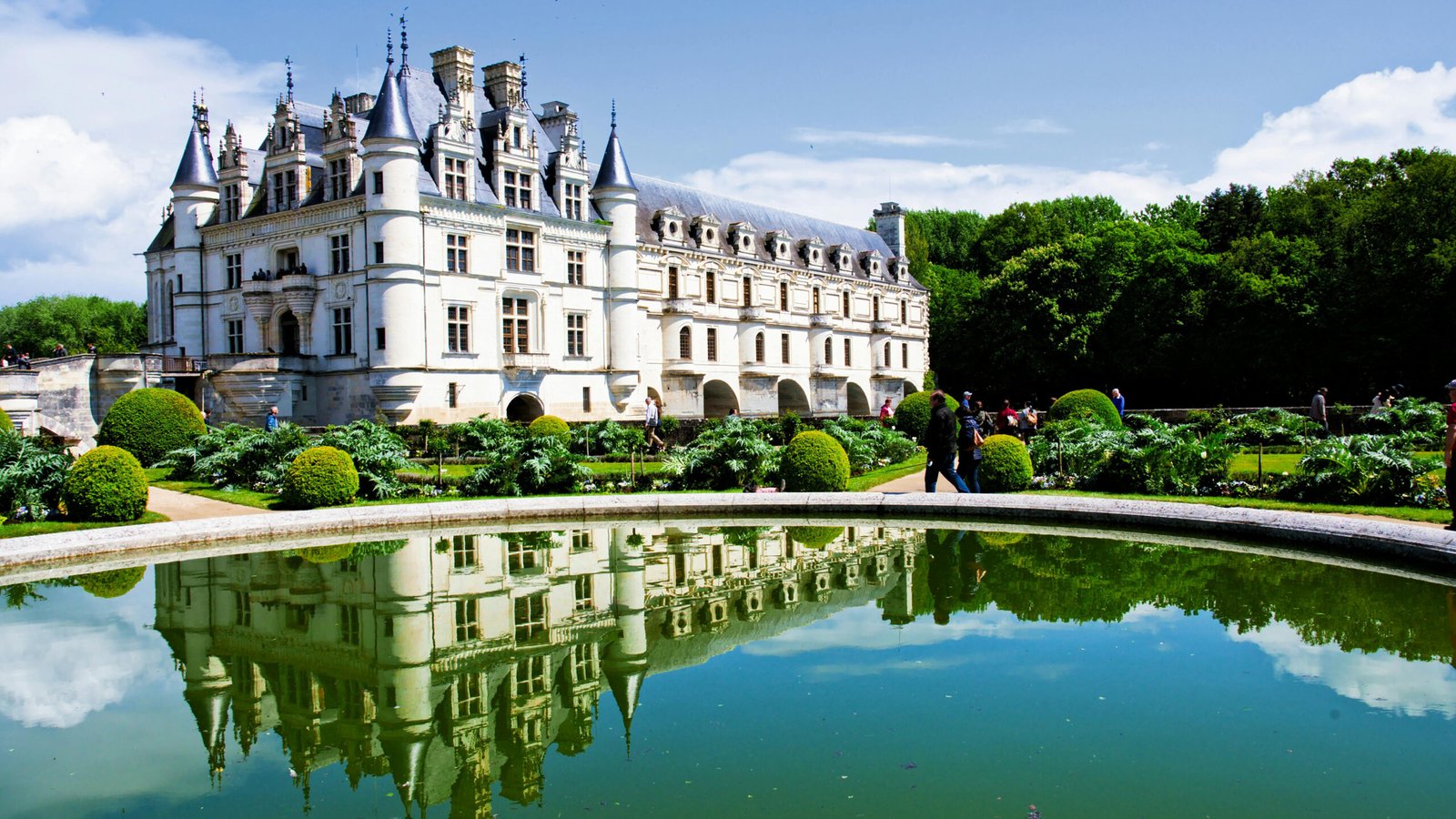
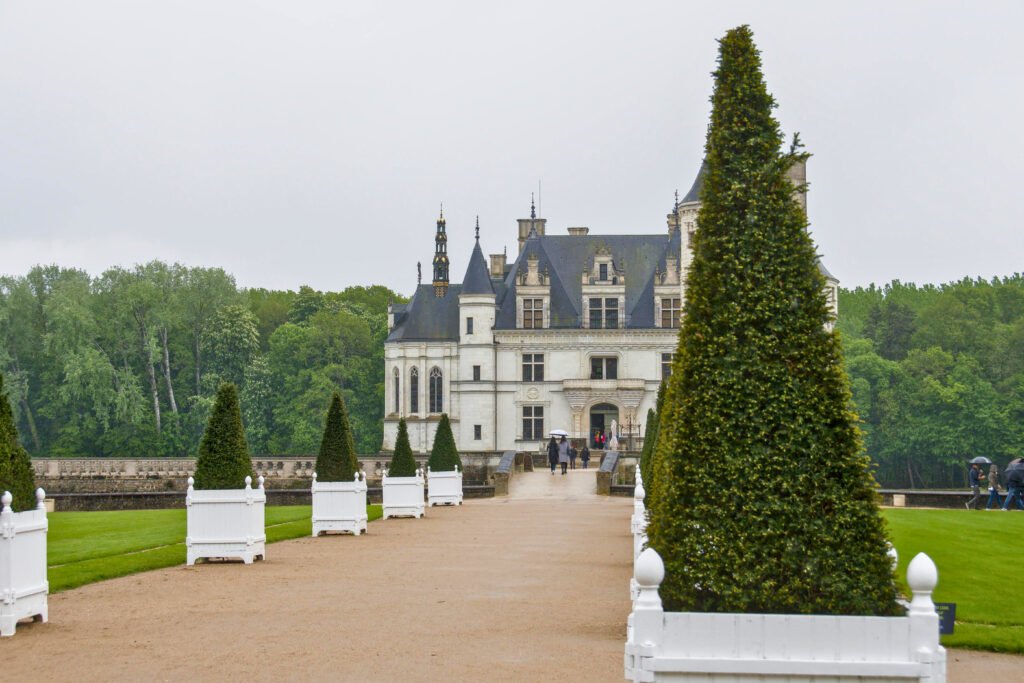
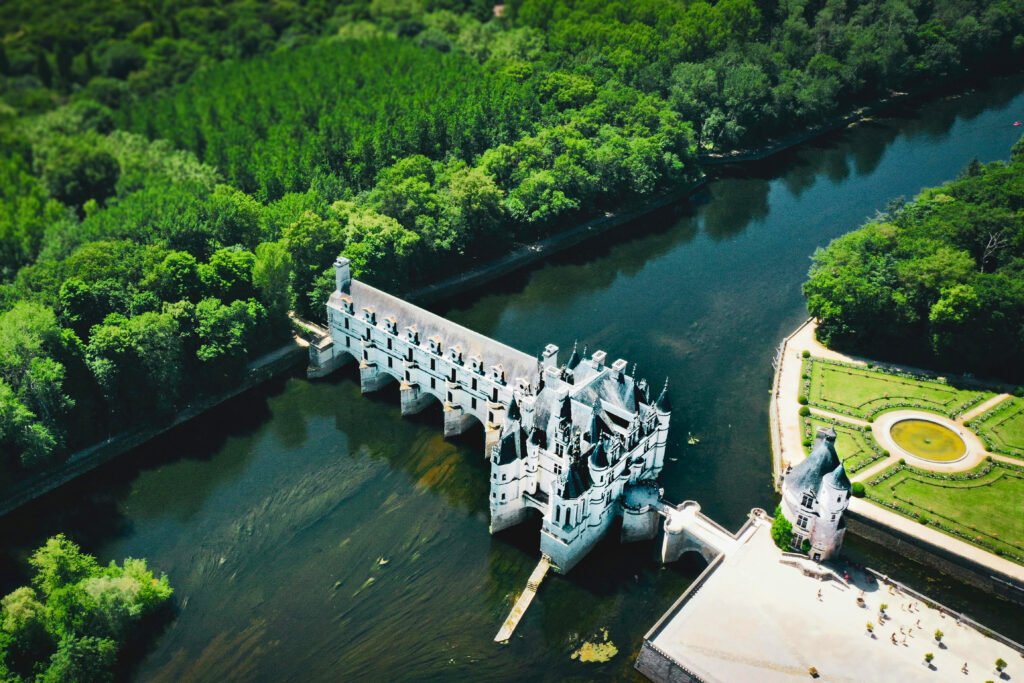
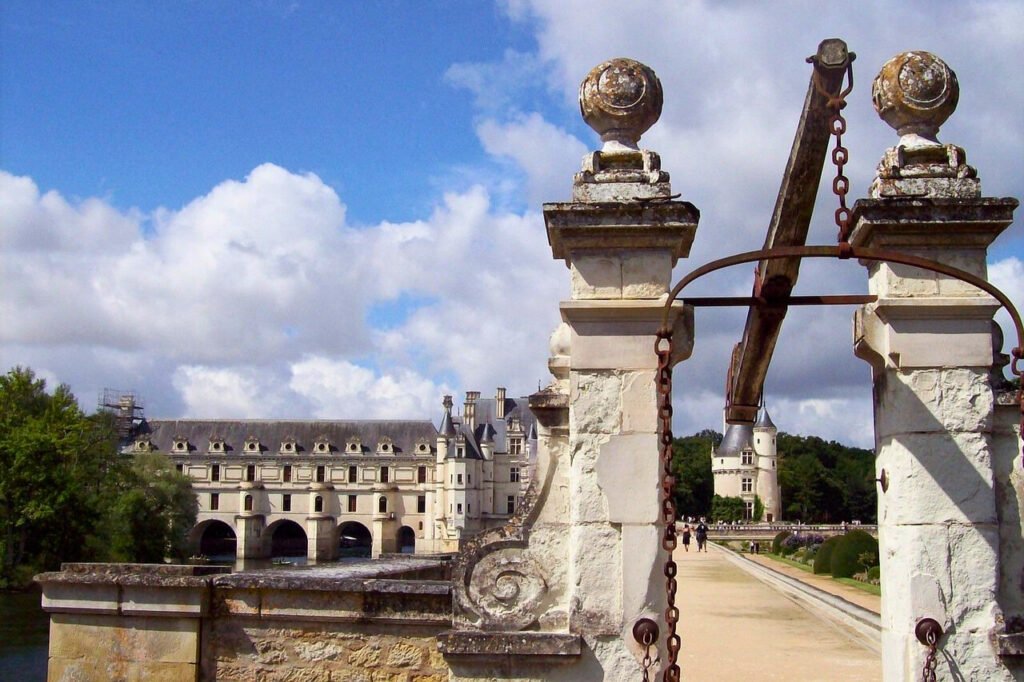
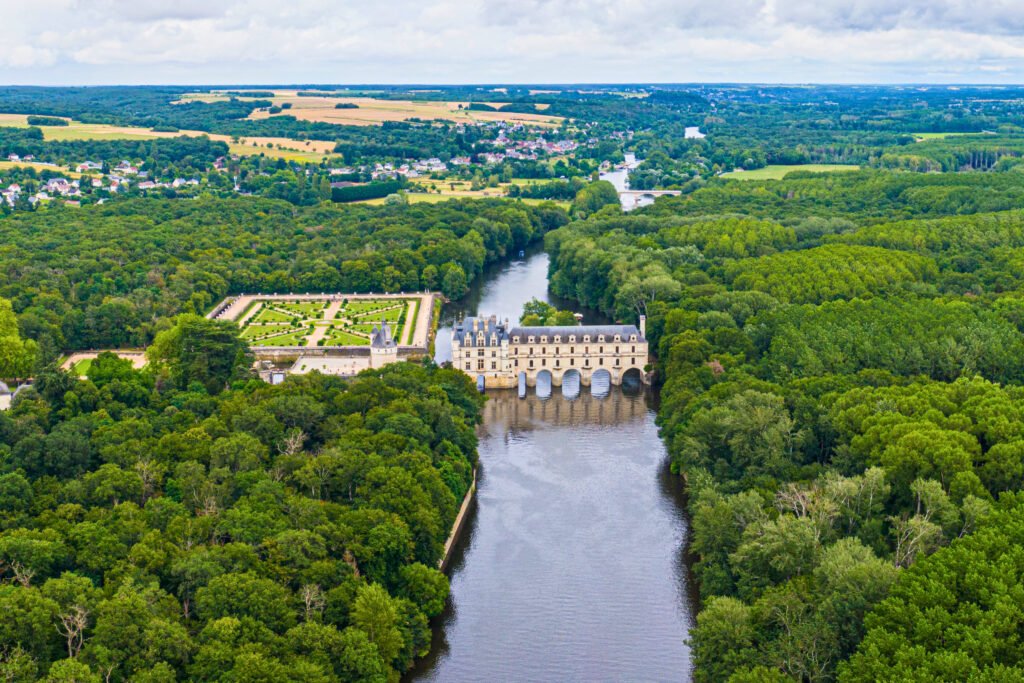
Few places in France announce themselves as quietly and confidently as Château de Chenonceau. You do not approach it with fanfare. You arrive, cross a tree-lined drive, and then it appears. Pale stone stretching across the Cher River, reflected perfectly in the water below. Not perched on a hill. Not ringed by walls. Just floating there, elegant and self-assured, as if it has always belonged to the river.
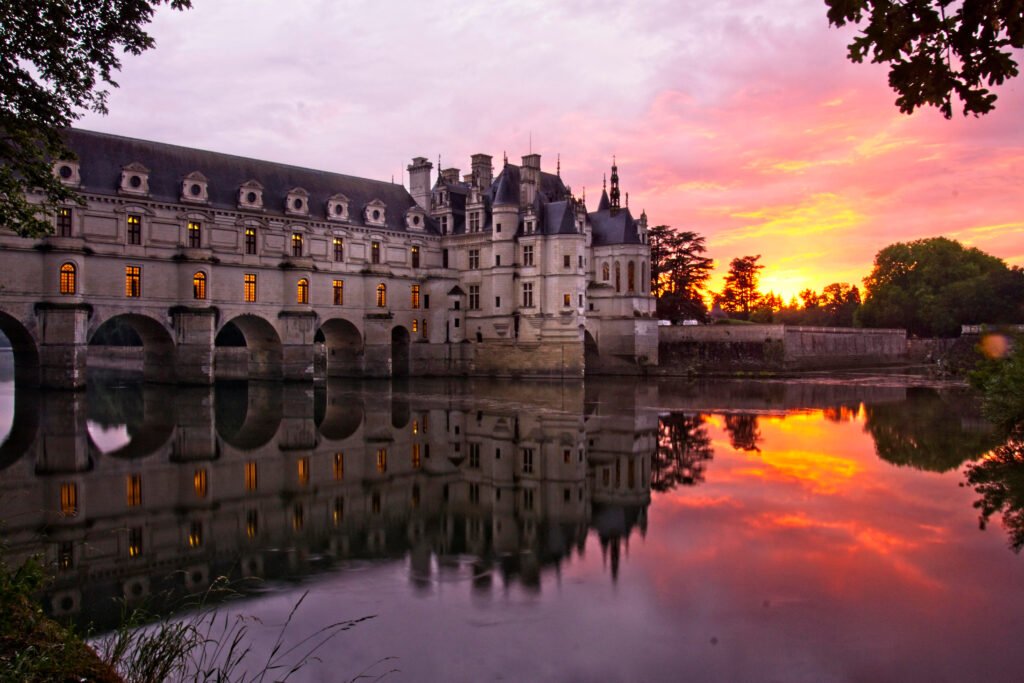
Chenonceau feels different from the moment you see it. Most Loire Valley châteaux impress through size or ornament. This one wins through balance. Architecture and landscape move together here. The arches touch the river lightly. The long gallery feels suspended between earth and water. On calm days, the château seems to double itself in reflection, like a painting that refuses to stay flat.
But what truly sets Chenonceau apart is not only how it looks. It is who shaped it.
Often called the “Château of the Ladies,” Chenonceau was defined, expanded, and protected by women at moments when power was rarely placed in their hands. Diane de Poitiers gave it grace and proportion. Catherine de’ Medici turned it into a political stage and architectural statement. Later, Louise de Lorraine transformed it into a place of mourning and quiet strength. Each left a visible mark. Not symbolic. Not subtle. You can walk through their decisions room by room.
That human presence is what lingers. The kitchens are tucked close to the river. The gardens lay out like opposing arguments. The gallery where footsteps echo above flowing water. Chenonceau does not feel frozen in time. It feels inhabited by memory.
For travelers, it is also one of the most rewarding castles to visit in France. Easy to reach. Manageable in scale. Rich in stories without feeling overwhelming. Whether this is your first château or your tenth, Chenonceau tends to become the one you remember most.
This guide explores the full story of Château de Chenonceau. Its history, its architecture, its gardens, and what it is like to visit today. If you are planning a trip to the Loire Valley, this is a place you do not rush. You slow down. And it rewards you for it.

Quick Facts – Château de Chenonceau at a Glance
📍 Location: Chenonceaux, Indre-et-Loire, Loire Valley, France
🏗️ Construction Period: 1513–1521 (main château), expanded mid-16th century
🏰 Architectural Style: French Renaissance with late Gothic influences
👑 Key Figures: Diane de Poitiers, Catherine de’ Medici, Louise de Lorraine
🎭 Famous For: Its gallery spanning the Cher River, powerful female patrons, and refined gardens
🏆 UNESCO Status: Yes — part of the Loire Valley (between Sully-sur-Loire and Chalonnes) World Heritage Site
🌐 Official Website: chenonceau.com
🕰️ Average Visit Time: 2 to 3 hours (longer if visiting gardens and exhibitions)
🚆 Nearest Major City: Tours (about 30 km)
🎟️ Best Known As: “The Château of the Ladies”

The Story of a Castle Built by Women
Long before it became the elegant silhouette stretching across the Cher River, Château de Chenonceau stood on contested ground. In the Middle Ages, this site was home to a fortified mill and castle belonging to the Marques family. Stone walls, a drawbridge, and defensive towers guarded a river crossing of real strategic value. It was practical. Functional. And, like many medieval strongholds, built for conflict rather than beauty.
That changed in the early 16th century, when Thomas Bohier, a high-ranking royal official under King Francis I, acquired the property. Together with his wife, Katherine Briçonnet, he ordered the demolition of most of the old fortress. What rose in its place was something new for the Loire Valley: a refined Renaissance residence, light-filled and symmetrical, positioned directly on the river’s edge. While Bohier’s name appears on official records, it was Briçonnet who oversaw much of the construction in his absence. From the start, Chenonceau was shaped by a woman’s eye for space, comfort, and proportion.
The château’s defining chapter began a generation later, when King Henry II offered Chenonceau to his longtime companion, Diane de Poitiers. This was no discreet country retreat. Diane transformed the château into a symbol of elegance and authority. She commissioned the graceful arched bridge that spanned the Cher, linking the château to the opposite bank. She redesigned the gardens with strict geometry and calm symmetry, creating an outdoor extension of the architecture itself.

Diane’s influence can still be felt in the château’s restraint. Her rooms emphasize balance rather than excess. Her garden is composed, orderly, and serene. Chenonceau under Diane was not about spectacle. It was about control.
That control ended abruptly in 1559, when Henry II died following a jousting accident. Power shifted overnight. Catherine de’ Medici, the king’s widow and one of the most formidable political figures of her time, reclaimed Chenonceau. Diane was forced to surrender the château in exchange for another property. What Catherine did next defined Chenonceau forever.
Where Diane built a bridge, Catherine built a gallery.
Stretching directly across the Cher atop the existing arches, the two-story gallery transformed Chenonceau from a riverside château into something entirely unique. It became a palace over water. Long, luminous, and ceremonial, the gallery served as a space for receptions, dances, and political gatherings. It was both an architectural ambition and a political theater. Catherine understood visibility. From this gallery, the château announced its power in every direction.
Catherine also reshaped the gardens. Her garden, set on the opposite side of the château from Diane’s, was more enclosed and intimate. Less open. More strategic. The contrast between the two gardens remains one of Chenonceau’s most telling features. They are not simply beautiful spaces. They are expressions of rivalry, personality, and vision, laid out in hedges and paths.
During Catherine’s years at Chenonceau, the château became a center of court life. Royal festivities, diplomatic receptions, and cultural events filled its rooms. Yet Catherine’s legacy is not only one of splendor. She ruled during a time of religious conflict and political instability. Chenonceau was a place of decision-making, negotiation, and survival.
After Catherine’s death, the château passed to Louise de Lorraine, widow of King Henry III. Her chapter is quieter, but no less powerful. Devastated by her husband’s assassination, Louise withdrew to Chenonceau and transformed it into a place of mourning. She wore white instead of the traditional black of royal widows, earning the nickname “the White Queen.” Her rooms were draped in somber colors, decorated with symbols of grief and remembrance. Walking through them today feels deeply personal. This is not royal propaganda. It is sorrow made visible.
In the centuries that followed, Chenonceau continued to evolve. It passed through noble families who preserved it rather than radically altering it. That sense of continuity would prove essential during times of crisis.
During World War I, the long gallery over the Cher was converted into a hospital ward. Rows of beds replaced courtly celebrations. Light poured in through the windows as wounded soldiers recovered above the flowing river. In World War II, Chenonceau once again played a role shaped by geography. The river marked the boundary between occupied and unoccupied France. The gallery became an escape route. One end lay in Nazi-controlled territory. The other offered a path to safety.
This history matters because it explains why Chenonceau feels alive. It has never been just a monument. It has adapted, sheltered, and endured. Its walls carry stories of ambition, rivalry, grief, resilience, and quiet defiance.
Most castles tell the story of kings. Chenonceau tells the story of women who shaped power without apology. That is not a marketing phrase. It is written into the stone, the gardens, and the water below.

Architecture & Design – A Château Like No Other
There is no mistaking Château de Chenonceau for any other castle in the Loire Valley. Its architecture does not dominate the landscape. It collaborates with it. Stone, water, and light work together so closely that the château feels less built than placed, as if the Cher River itself dictated the design.
The original Renaissance château, constructed in the early 16th century, sits directly on the piers of an old mill. This decision alone sets Chenonceau apart. Most châteaux were defensive or symbolic, designed to rise above their surroundings. Chenonceau does the opposite. It stretches outward. Horizontally. Calmly. Its pale limestone façade reflects softly in the water, changing color with the time of day and the season.
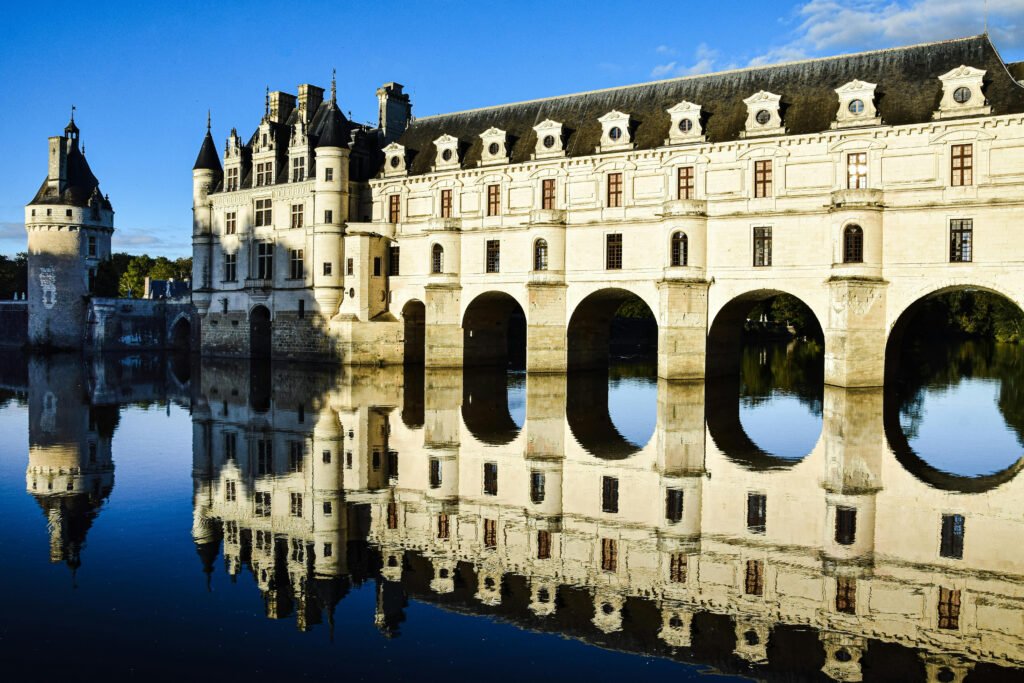
The plan of the main building is compact and balanced. Inside, rooms unfold in a logical sequence rather than a grand procession. Ceilings are not excessively high. Windows are large and plentiful. Light is constant. The effect is intimate rather than overwhelming, closer to a refined residence than a royal fortress.
One of the most striking architectural features is the central staircase. Unlike the grand spiral staircases found in other Renaissance châteaux, Chenonceau’s staircase is straight and ceremonial. It rises with quiet confidence, framed by clean lines and sculpted details. This was a deliberate choice, reflecting Renaissance ideals of order and clarity over medieval defensiveness.
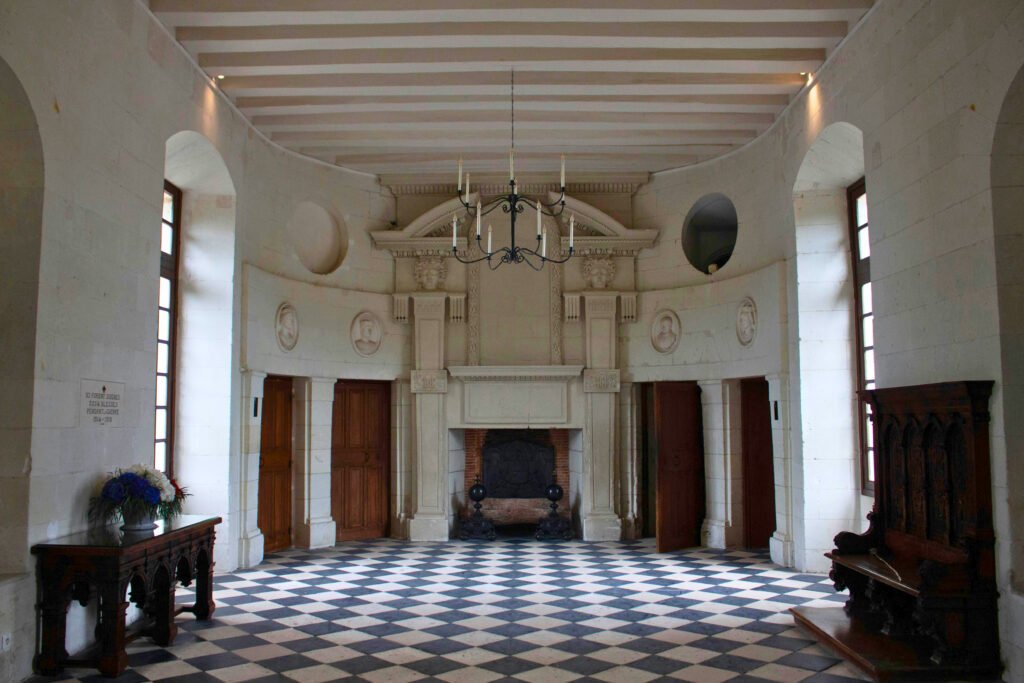
As you move through the rooms, architectural restraint becomes the defining theme. Fireplaces are finely carved but not ostentatious. Wooden ceilings show careful craftsmanship without excess. Floors alternate between polished wood and patterned tile, grounding each space in texture. Nothing competes for attention. Everything feels considered.
Then you reach the gallery.
Built by Catherine de’ Medici atop Diane de Poitiers’ bridge, the gallery is the architectural heart of Chenonceau. Measuring nearly sixty meters in length, it stretches across the Cher with a row of tall windows on both sides. Light floods the space from dawn to dusk. The black-and-white tiled floor anchors the room, while the ceiling remains deliberately simple, allowing the rhythm of the windows to take center stage.
Standing in the gallery feels unlike standing in any other château room in France. You are suspended over water. You sense movement beneath your feet. The river flows silently below, visible through the arches when you look out from the windows. During court festivities, this space would have been filled with music, conversation, and motion. Today, it invites a slower pace. People instinctively lower their voices here.
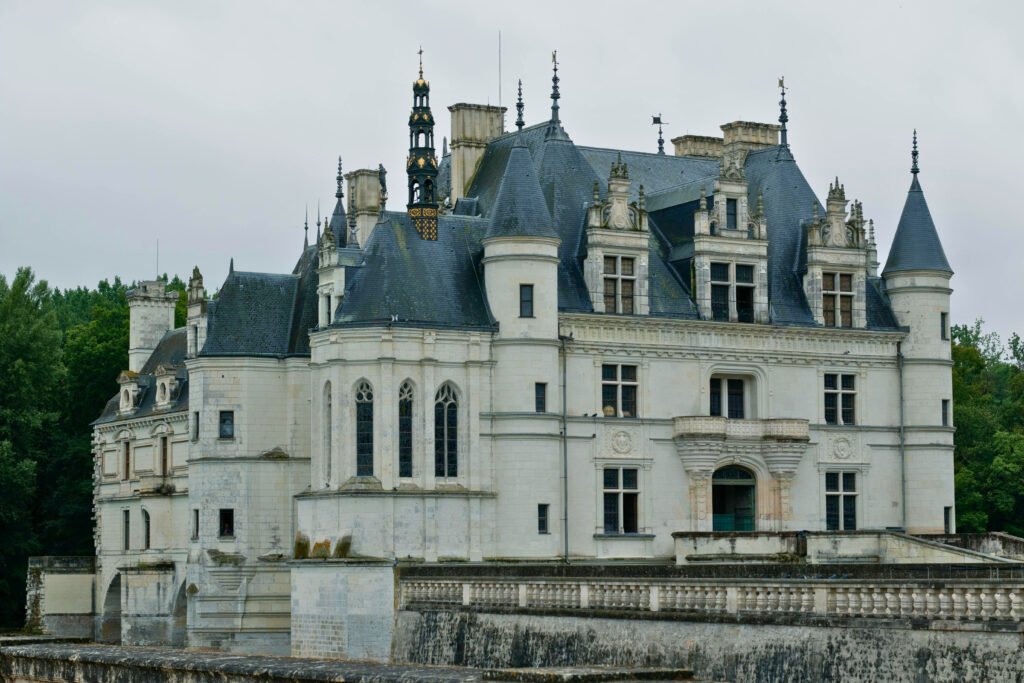
Beyond the gallery, the château reveals its functional intelligence. The kitchens, located at water level beneath the main building, are among the most fascinating in the Loire Valley. They were designed for efficiency, not display. Large fireplaces, stone sinks fed directly by the river, and storage rooms carved into the structure show how closely architecture and daily life were intertwined. This was a working household, not a theatrical set.
Chenonceau’s relationship with symmetry is subtle. From a distance, the château appears perfectly balanced. Up close, small variations emerge. Rooms differ slightly in size. Decorative details shift from one space to another. These variations give the château warmth. It feels lived in, not replicated.
What ultimately defines Chenonceau’s design is how seamlessly it integrates feminine influence without labeling it as such. There is no overt softness. No decorative excess. Instead, there is precision, proportion, and flow. Spaces connect naturally. Views are framed intentionally. Transitions from indoors to outdoors feel effortless.
This architectural intelligence explains why Chenonceau photographs so beautifully, yet never feels like it exists for the camera alone. It was designed to be inhabited, observed, and experienced slowly. The river is not a backdrop. It is part of the structure. The light is not incidental. It is essential.
In a region filled with monumental castles, Chenonceau stands apart by refusing monumentality. Its power lies in elegance, clarity, and the quiet confidence of a design that has never needed to shout to be remembered.
The Gardens of Chenonceau – Order, Power, and Beauty
The gardens of Château de Chenonceau are not decorative afterthoughts. They are statements. Carefully planned, fiercely symbolic, and deeply personal, they tell a story of rivalry and vision that mirrors the château’s history as clearly as its stone walls.
Two gardens define Chenonceau, and they could not be more different.
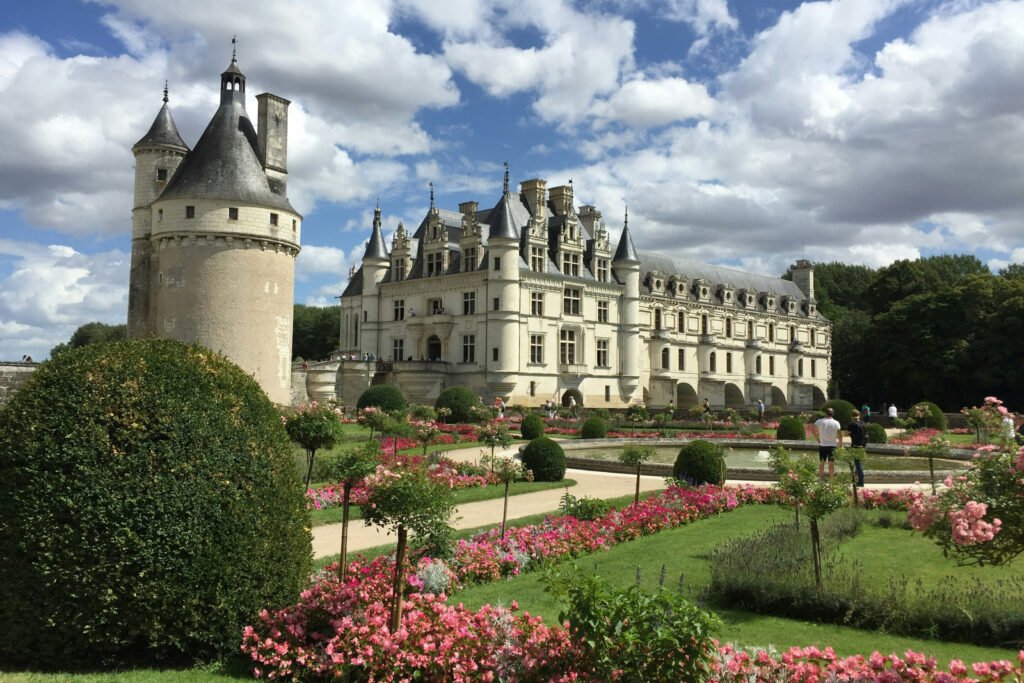
The first is the Garden of Diane de Poitiers. Laid out in perfect symmetry, it feels open, measured, and calm. Straight paths divide geometric flowerbeds bordered by low hedges. At the center, a fountain anchors the space, reflecting the sky above and reinforcing the sense of balance. From this garden, the château rises gracefully behind you, its arches and windows aligned with the garden’s clean lines.
Diane’s garden is about control without rigidity. There is structure, but also lightness. Seasonal flowers soften the geometry, bringing color and movement into an otherwise disciplined layout. It is a garden designed to be admired, walked through, and understood at a glance. Much like Diane herself, it projects confidence without excess.
Across the château lies the Garden of Catherine de’ Medici, and the shift in atmosphere is immediate. This garden is more enclosed, framed by terraces and higher boundaries. It feels inward-looking. Intimate. Strategic. Where Diane’s garden opens outward to the river, Catherine’s turns back toward the château, emphasizing proximity to power rather than display.
The design here favors contrast over symmetry. The central basin reflects the surrounding greenery, but the paths invite wandering rather than procession. There is a sense of movement, of observation. Catherine’s garden was a place to receive guests, hold conversations, and observe without being observed. It is quieter, but more complex.
Walking between the two gardens feels like crossing an invisible line. They are close in distance, yet worlds apart in intention. Together, they reveal how landscape design can express personality, authority, and rivalry without a single word spoken.
Beyond these formal gardens, Chenonceau opens into broader green spaces. The parkland extends gently, offering shaded paths and framed views of the château from unexpected angles. From certain points, the building seems to hover above the water, its reflection broken only by ripples from the river below. These viewpoints are not accidental. They are carefully preserved sightlines, designed to reward slow exploration.
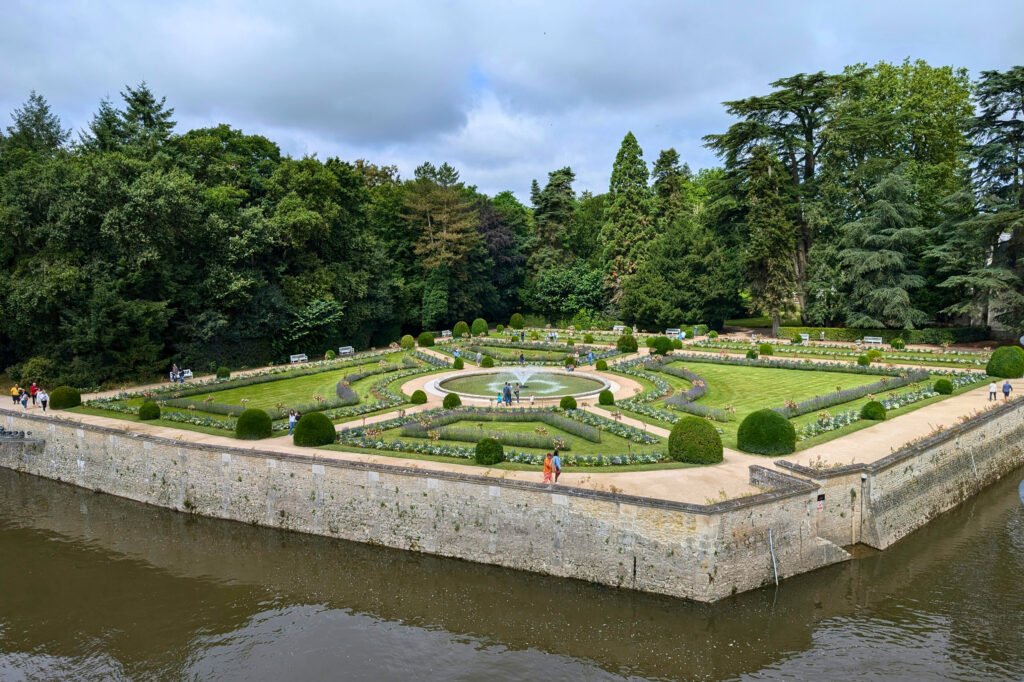
Season plays a major role in how the gardens are experienced. In spring, tulips and flowering trees bring softness and renewal. Summer fills the air with scent and color, the gardens at their most theatrical. Autumn introduces warm tones and long shadows, while winter strips the landscape back to its structure, revealing the bones of the design.
One of the most understated pleasures of Chenonceau is simply sitting in the gardens and watching the château change with the light. Morning brings clarity. Midday sharpens contrasts. Late afternoon bathes the stone in gold.
These gardens do not exist to overwhelm. They exist to frame, to balance, and to reveal. Like the château itself, they reward patience. And once you understand the story they tell, you realize you are not just walking through planted space. You are walking through power, ambition, and quiet defiance shaped into earth and stone.
Visiting Château de Chenonceau Today – Practical Tips and What to Expect
Visiting Château de Chenonceau is refreshingly straightforward, especially compared to some of the Loire Valley’s more remote castles. It is one of the most accessible, best-organized, and genuinely rewarding château visits in France. That combination explains its popularity and also why a little planning makes a big difference.
🛣️ How to Get There
Chenonceau sits east of Tours, right in the heart of the Loire Valley. From Paris, the easiest route is by train. High-speed trains run from Paris Montparnasse to Tours in about an hour. From Tours, regional trains reach the small station of Chenonceaux in roughly 30 minutes. The walk from the station to the château takes about 15 minutes and passes through the village and along a quiet road lined with trees.
If you are driving, Chenonceau is clearly signposted and easy to reach. Parking is well organized and located a short walk from the entrance. For travelers exploring multiple Loire castles, a car offers flexibility, but Chenonceau is one of the few major sites that works just as well without one.
🎟️ Tickets, Entry, and Tours
Chenonceau operates with timed-entry tickets during busy periods, especially from spring through early autumn. Booking online in advance is strongly recommended. It saves time and removes uncertainty, particularly during weekends and school holidays.
For the most up-to-date information on opening times and current ticket prices, check the official page for the castle. It’s updated regularly and gives you a clear picture of what to expect before you arrive.
Once inside, visitors follow a logical route through the château that flows naturally from room to room. An audio guide is available for a small extra fee and is worth using. It provides clear context without overwhelming detail and allows you to move at your own pace.
Guided tours are available but not essential. The château’s layout and interpretation are intuitive, and much of the experience comes from observation rather than explanation. That said, travelers with a strong interest in Renaissance history or women’s history may appreciate the added depth a guide can offer.
📅 Best Time to Visit
Chenonceau is open year-round, and each season brings a different mood. Late spring and early summer offer the gardens at their most vibrant, but this is also the busiest time. Arriving early in the morning or later in the afternoon helps avoid peak crowds.
Autumn is an underrated season to visit. The light is softer, the gardens remain beautiful, and visitor numbers drop noticeably. Winter, while quieter and more atmospheric, limits access to certain outdoor areas and offers fewer flowers, but the château itself feels more intimate.
Golden hour is particularly special here. As the sun lowers, the stone warms in color, and reflections on the Cher River become more dramatic. If your schedule allows, aim to be in the gardens or gallery during this time.
⏱️ How Long to Plan
A typical visit takes two to three hours, including the château interior and gardens. Travelers who enjoy photography, slower exploration, or simply sitting and observing may easily spend longer. Chenonceau is not a place to rush. Its appeal lies in transitions, reflections, and atmosphere as much as in individual rooms.
♿ Accessibility and Visitor Comfort
Chenonceau is among the more accessible historic sites in the Loire Valley. The grounds are largely flat, and elevators allow access to multiple levels of the château. Staff are helpful and clearly accustomed to assisting visitors with mobility needs.
Families are welcome, and children tend to enjoy the visual drama of the river-spanning gallery and the scale of the gardens. Strollers are allowed, though narrow passages inside the château may require occasional adjustments.
Facilities are excellent. Restrooms are clean and well-placed. There is a bookshop with a strong focus on history and architecture, as well as a café offering light meals and refreshments. Picnic areas are available nearby for those who prefer to bring their own food.
💡 Practical Tips Worth Knowing
Arrive earlier than your ticket time if possible. Even with timed entry, security checks, and ticket validation take time.
Start with the château interior before heading to the gardens. Crowds tend to build outside as the day progresses.
Do not skip the lower levels. The kitchens and service areas near the river are some of the most revealing spaces in the entire visit.
Slow down in the gallery. Many visitors walk straight through. Standing still for a few minutes changes the experience entirely.
Check the château’s event calendar. Seasonal exhibitions, floral installations, and evening openings add depth to repeat visits.
Chenonceau succeeds because it respects the visitor’s time and curiosity. It offers depth without confusion, beauty without excess, and history without distance. Whether you are visiting one château or many, Chenonceau feels complete. And that sense of completeness is rare.
The Château in Art, War, and Memory
Beyond its architectural beauty, Château de Chenonceau carries a quieter legacy shaped by crisis, creativity, and survival. It has never been a passive backdrop to history. Again and again, it adapted to the needs of the moment.
During World War I, Chenonceau’s famous gallery took on a radically different role. The long, light-filled space that once hosted royal celebrations was transformed into a hospital ward. Beds lined the tiled floor. Medical staff moved through the windows’ rhythm instead of dancers. Over 2,000 wounded soldiers were treated here, suspended above the river in a space designed for beauty but repurposed for care. The château’s architecture, intended for elegance, proved unexpectedly humane.
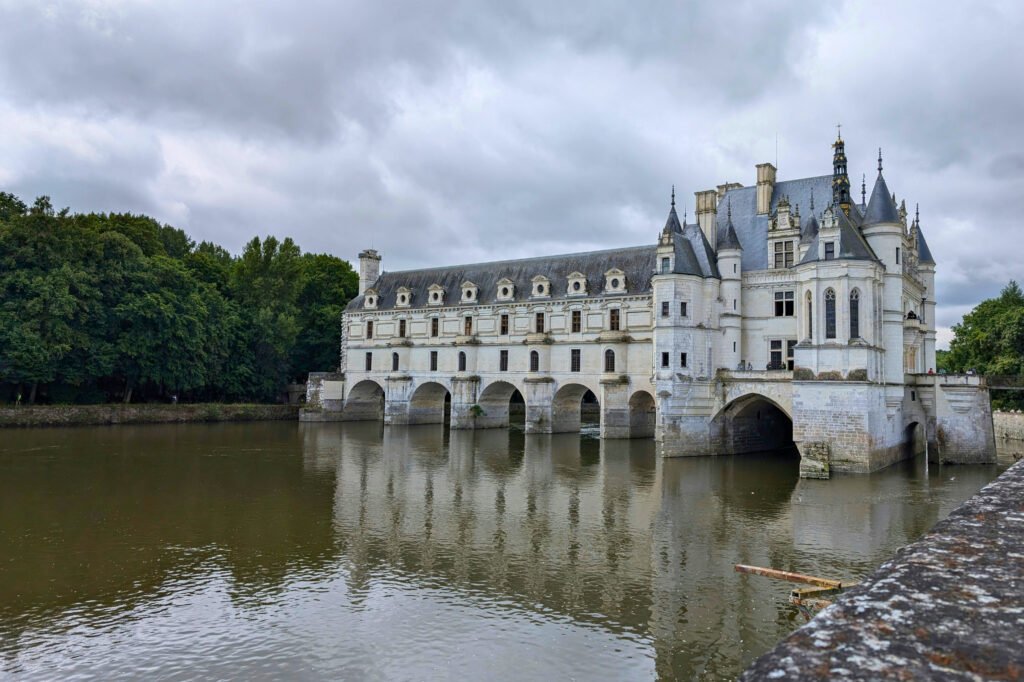
World War II brought a different kind of tension. The Cher River marked the boundary between occupied France and the so-called free zone. Chenonceau sat directly on that line. One end of the gallery lay under German control. The other opened into unoccupied territory. The château became a silent crossing point, allowing members of the Resistance and those fleeing persecution to pass through its halls and disappear beyond the river. No dramatic monuments mark this role. Its power lies in discretion, in doors quietly opened and choices made without spectacle.
Art has also long been part of Chenonceau’s identity. Unlike many châteaux that emptied their interiors over time, Chenonceau retained and rebuilt its collections. Today, visitors encounter tapestries, paintings, and furniture selected not for grandeur alone but for harmony with the space. Works by masters such as Rubens hang alongside Flemish tapestries and Renaissance portraits, reinforcing the château’s lived-in quality rather than turning it into a static museum.
Literature and popular culture have continued this legacy. Chenonceau appears in novels, travel writing, and historical accounts as a symbol of elegance shaped by intelligence rather than force. Filmmakers and photographers return to it not because it overwhelms, but because it balances. Light, water, and stone do much of the work for them.
What connects these moments is continuity. Chenonceau has absorbed each era without losing itself. It has served as a residence, hospital, refuge, and cultural landmark, adapting without erasing what came before. Memory here is layered, not overwritten.
That layered memory is part of what visitors sense instinctively. The château feels present. Not preserved behind glass. Not staged for effect. Its beauty carries weight because it has been tested, used, and protected in moments that mattered. Chenonceau does not simply reflect history. It remembers it.
What to See Nearby – Making the Most of Your Visit
One of the great advantages of visiting Château de Chenonceau is how naturally it fits into a broader Loire Valley itinerary. The surrounding area offers a mix of historic towns, additional châteaux, and gentle landscapes that pair well with Chenonceau’s elegance rather than competing with it.
Just a short drive or train ride away lies Amboise, a lively riverside town with a strong royal past. The Château Royal d’Amboise rises above the Loire and offers sweeping views over the valley. It feels more fortified and political than Chenonceau, which makes the contrast rewarding. Within walking distance, Clos Lucé adds another layer of interest. This was Leonardo da Vinci’s final home, and its focus on creativity, invention, and daily life complements Chenonceau’s human scale beautifully.
For travelers interested in contemporary culture alongside historic settings, Château de Chaumont-sur-Loire is an excellent addition. Known for its annual International Garden Festival, Chaumont blends historic architecture with modern landscape design. Visiting after Chenonceau highlights how garden design continues to evolve while drawing inspiration from the past.
Those who prefer a slower pace can stay closer to Chenonceau itself. The surrounding countryside is dotted with vineyards producing Touraine wines, many of which welcome visitors for tastings. These are not large, commercial estates. They tend to be small, family-run operations where conversation matters as much as the wine. A late afternoon tasting fits naturally after a morning at the château.
The nearby city of Tours works well as a base. It offers a historic old town, lively food scene, and easy transport connections. For travelers without a car, Tours makes visiting Chenonceau and other Loire sites surprisingly simple.
What makes this region special is not just the density of landmarks, but the way they connect. Chenonceau pairs best with places that respect rhythm and contrast. One strong château visit. One town. One garden. One glass of local wine. The Loire Valley rewards balance, and Chenonceau sets that tone perfectly.
FAQ – Château de Chenonceau
How long should I plan for a visit?
Most visitors spend 2 to 3 hours exploring the château and gardens. If you enjoy photography or slower exploration, plan closer to half a day.
Is Château de Chenonceau worth visiting if I only have time for one Loire Valley castle?
Yes. Château de Chenonceau is often the best single choice thanks to its unique river setting, rich history, and manageable scale.
Do I need to book tickets in advance?
During spring, summer, and weekends, advance booking is strongly recommended. Timed-entry tickets help avoid long waits.
What is the best time of day to visit?
Early morning offers the calmest experience. Late afternoon is ideal for light and reflections on the river, especially for photos.
Can I visit Chenonceau without a car?
Yes. Regular trains run from Tours to Chenonceaux station, followed by a 15-minute walk to the château.
Is the château suitable for children?
Yes. Families are welcome, and children often enjoy the gallery overlooking the river and the open gardens. Audio guides include kid-friendly options.
Is Chenonceau accessible for visitors with reduced mobility?
Largely yes. The grounds are mostly flat, elevators provide access to multiple levels, and staff are helpful and attentive.
Are the gardens included in the ticket price?
Yes. Access to both the château interior and gardens is included with standard admission.
Can I take photos inside the château?
Photography is allowed without flash in most areas. Tripods are not permitted inside.
What makes Chenonceau different from other Loire castles?
Its gallery spanning the river, its strong female legacy, and its intimate scale set it apart. Chenonceau feels lived in, not monumental.
Final Thoughts – Why Chenonceau Stays With You
Some castles impress you while you are there and fade once you leave. Château de Chenonceau does the opposite. It settles in quietly and returns to you later, in reflections, in remembered light, in the feeling of standing above moving water.
Part of this comes from its scale. Chenonceau never overwhelms. You are invited to notice details rather than conquer space. The curve of an arch. The rhythm of windows in the gallery. The way the gardens frame the château instead of competing with it. Everything feels intentional, and that intention is readable even centuries later.
More than anything, Chenonceau endures because of the people who shaped it. Not abstract rulers or distant legends, but individuals whose choices are still visible. You walk through ambition, rivalry, grief, and resilience. These stories are not hidden in plaques. They are built into the rooms and paths.
For travelers exploring the Loire Valley, Chenonceau offers something rare. It feels complete. You leave without the sense that something essential was missed. Whether this is your first château or your last, it often becomes the one you measure the others against.
💬 If you’ve visited Château de Chenonceau, your experience may differ slightly from someone else’s—and that’s exactly the point. Some remember the quiet of the gallery above the river. Others linger in the gardens or the stories of the women who shaped the place. If you feel like sharing what stayed with you most, we’d love to hear it.
👉 If you’re planning your first visit, think of this article as a beginning, not a finale. France’s castle landscape is far richer than a single stop. From Loire Valley masterpieces built for elegance and court life, to powerful medieval fortresses and refined Renaissance palaces, each château reflects its region, its history, and a moment when architecture and power aligned.
🏰✨ Thanks for reading. If this guide helped you, continue exploring with our in-depth features on 10 Unforgettable Castles to Visit in France Today, Exploring the Loire Valley Castles: France’s Château Country, and 25 Best Castles to Visit in Europe: Iconic & Hidden Gems. You can also follow CastleQuest Chronicles on Instagram, Facebook, Pinterest, YouTube, TikTok, and X for more castle stories and travel inspiration. Many more castles, and many more stories, are waiting.